What Is an Architectural Plan — and Why Does It Matter?
An architectural plan is a set of technical drawings that defines every aspect of a building project — from room sizes and wall placement to structural details and site layout.
Here’s a quick breakdown of what an architectural plan set typically includes:
| Drawing Type | What It Shows |
|---|---|
| Floor Plan | Overhead view of rooms, walls, doors, and windows |
| Site Plan | Property boundaries, setbacks, utilities, and landscaping |
| Elevations | Exterior views of each side of the building |
| Sections | Vertical cuts showing structural layers and interior height |
| Reflected Ceiling Plan | Lighting, electrical, and ceiling features |
| Schedules | Specifications for doors, windows, and materials |
These architectural plan drawings serve three core purposes:
- Communicate the design to clients, contractors, and building officials
- Guide construction with precise dimensions and material specs
- Ensure compliance with local building codes and zoning regulations
Whether you’re renovating a home or developing a commercial property, an architectural plan is the foundation of a successful, stress-free project.
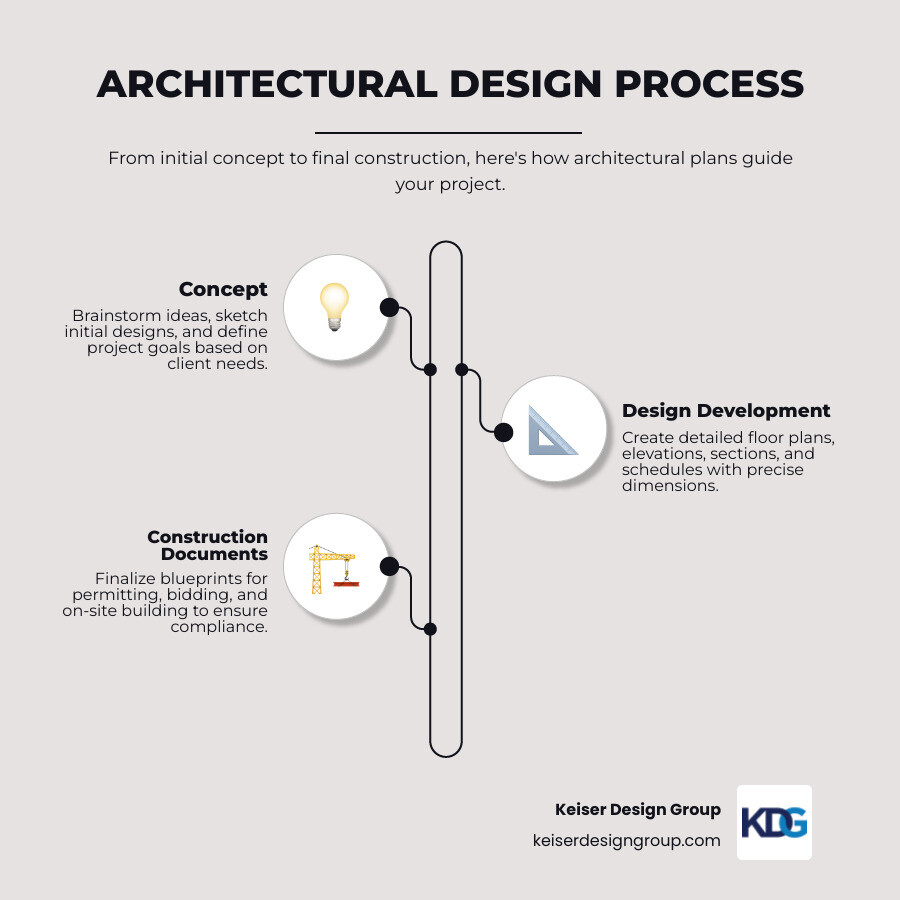
I’m Dan Keiser, founder and principal architect of Keiser Design Group, and over my 30+ years of practice, I’ve guided countless clients through every stage of the architectural plan process — from the first sketch to the final construction document. In the sections ahead, I’ll break down exactly what goes into a complete plan set and what you need to know before your project begins.
Understanding the Core Components of an Architectural Plan
An architectural plan tells the full construction story—site, structure, systems, and finishes—in coordinated drawings. A complete set of drawings, often called a blueprint set or construction documents, goes far beyond just showing where the walls go. It integrates site development, structural integrity, and aesthetic finishing.
At Keiser Design Group, we ensure every architectural plan set includes a site development plan to show the building’s location on the land, floor plans for interior flow, elevations for exterior style, and sections to reveal the “bones” of the structure. We also include detailed schedules—think of these as organized lists—that specify exactly which windows, doors, and finishes are required. These components work together to provide a Building Plans and Designs framework that leaves no room for guesswork during construction.
The Role of the Floor Plan within an Architectural Plan
The floor plan is often the most recognizable sheet in an architectural plan set. It is an orthographic projection, a fancy way of saying an overhead view, looking down on the proposed space. Imagine taking a giant saw and cutting the house horizontally about four feet above the floor, then looking straight down.
On a typical house plan, you will see parallel lines representing the thickness of the walls (usually 2×4 or 2×6 studs plus finishes). The plan specifies room sizes, wall lengths, and the exact placement of built-in elements like kitchen cabinets and bathroom fixtures. It acts as the primary map for the interior of your home, ensuring that every square foot is utilized efficiently.
Site Plans and Exterior Elevations
While the floor plan handles the “inside,” the site plan and exterior elevations handle the “outside” and the “context.” In an architectural plan set, the site plan shows property lines, required setbacks (how far the building must be from the edge of the lot), and the location of utilities like water and sewer lines. It also accounts for topography—the slope of your land—and landscaping features.
In an architectural plan, exterior elevations show two-dimensional drawings of each side of the building. These aren’t just for show; they indicate the heights of roofs, the placement of windows, and the types of materials (like brick, siding, or stone) that will be used. They help us visualize how the building sits on the site and how it will look to neighbors and passersby.
Specialized Views: Sections and Reflected Ceiling Plans
To build a house safely and accurately, we need to look “under the skin.” In an architectural plan, sections reveal what’s inside the walls, floors, and roof. If the floor plan is a horizontal slice, the section is a vertical one.
Sections are vital for understanding structural layers, such as how the foundation meets the walls and how the roof connects to the frame. They show how layers like structure, insulation, and moisture protection work together. You can learn more about the technical nature of these views through Scientific research on sectional views.
Why an Architectural Plan Includes Reflected Ceiling Plans
In an architectural plan set, a Reflected Ceiling Plan (RCP) maps ceiling elements. It’s drawn as if the ceiling were reflected onto the floor, so it aligns with the floor plan. This allows the orientation of the RCP to match the floor plan exactly, making it much easier for contractors to coordinate.
In an architectural plan, the RCP focuses on lighting and electrical placement. By separating this information from the main floor plan, we avoid “cluttering” the drawings, making them easier to read.
The Importance of Door Swings in Ceiling Layouts
One common question we get is: “Why do you show doors on a ceiling plan?” It seems counterintuitive, but it’s actually a best practice in residential design. We represent doors and their swings using dashed lines.
The reason is simple: coordination. If we know exactly where a door swings, we can ensure that light switches aren’t accidentally placed behind an open door. There is nothing more frustrating than walking into a dark room and having to close the door just to reach the switch! Including these swings helps us cross-reference the lighting symbols with the physical movement of the space.
The Evolution of Drafting and Construction Compliance
The way we create an architectural plan has changed dramatically over the years. We’ve moved from the days of manual drafting with T-squares and ink pens on vellum to sophisticated digital tools. While the artistry remains, the precision has reached new heights.
Today, we use CAD and BIM—tools that help coordinate drawings and reduce field surprises. BIM is particularly powerful because it creates a 3D digital model of the building where every element, from a 2×4 stud to a light fixture, contains data. This helps us spot conflicts early, like a duct path crossing a structural beam, before construction. You can explore the transition from hand-drawing to digital in our article on Architectural Drafting and Design.
Building Codes and Customization
A major part of our job at Keiser Design Group is ensuring your architectural plan complies with local building codes. Whether you’re in Columbus or Houston, an architectural plan must align with local zoning and code requirements.
For commercial projects, this involves even more rigorous steps, such as calculating plumbing fixture counts based on occupant load and ensuring ADA (Americans with Disabilities Act) accessibility. We handle these Commercial Architecture Design Steps so you can focus on the vision for your business.
Avoiding Common Mistakes in Plan Reading
One of the most dangerous mistakes a builder or homeowner can make is “scaling off” a drawing. While plans are drawn to scale (like 1/4″ = 1′-0″), paper can shrink or expand, and digital screens can distort.
Always follow the written dimensions provided on the plan. In the architectural world, written dimensions always take precedence over the physical scale of the drawing. If a dimension seems missing or incorrect, we perform field verification to ensure the plan matches the real-world conditions.
| Feature | Manual Drafting | BIM (3D Modeling) |
|---|---|---|
| Speed of Changes | Slow (Requires erasing/redrawing) | Fast (Updates all views automatically) |
| Coordination | Manual (High risk of error) | Automated (Clash detection) |
| Visualization | 2D Only | Full 3D Walkthroughs |
| Data Integration | None | High (Material quantities/specs) |
Frequently Asked Questions about Architectural Plans
What is the most common scale for house plans?
In the United States, we use the Imperial Measurement System. The most common scale for a residential architectural plan is 1/4″ = 1′-0″. This means that every quarter-inch on the paper represents one foot in the real world. For larger site plans, we might use 1″ = 20′, and for intricate details like how a window meets a wall, we might go as large as 1-1/2″ = 1′-0″ or even full size.
How do modern open floor plans impact architectural design?
Modern design often favors “open floor plans,” which minimize interior walls to create large, unobstructed spaces. This style was heavily influenced by architects like Ludwig Mies van der Rohe, who championed “skin and bones” architecture.
To achieve these wide-open spans without walls for support, we use modern technologies like engineered lumber, steel beams, and trusses. These allow for a seamless flow of natural light and better family interaction, though they require more careful structural planning in the initial architectural plan.
What is the difference between working drawings and record drawings?
- Working Drawings: These are the “blueprints” used for the actual construction. They provide the instructions for the builders and the documents for the permit office.
- Record Drawings (As-Builts): During construction, things often change slightly. Maybe a pipe had to be moved six inches to the left. Record drawings are created after the project is finished to reflect exactly how the building was actually constructed. These are invaluable for future renovations or maintenance.
Conclusion
Creating a comprehensive architectural plan is about more than just drawing lines on paper; it’s about creating a roadmap for your future. At Keiser Design Group, we deliver clear, coordinated architectural plan sets and guide clients through a straightforward process across Ohio, Texas, Kentucky, Indiana, and Tennessee.
Whether you are in Columbus, Indianapolis, or Nashville, our team is ready to help you turn your vision into a technical reality. We handle the complexities of building codes, structural details, and site integration so you can enjoy the excitement of building your dream space.
Ready to start your project? Contact our team for your next project, and let’s build something incredible together.