What Are the Parts of a Church Building?
The parts of a church building include both interior and exterior elements, each with a specific name, history, and purpose. Here is a quick overview of the most common ones:
| Part | Location | Primary Purpose |
|---|---|---|
| Narthex | Entrance | Transitional gathering space |
| Nave | Central interior | Main seating area for the congregation |
| Chancel | Front of nave | Area for clergy and choir |
| Sanctuary | Innermost area | Houses the altar; most sacred space |
| Transept | Crosses the nave | Creates the cruciform (cross) shape |
| Apse | Eastern end | Semi-circular recess behind the altar |
| Aisle | Sides of nave | Circulation and secondary seating |
| Ambulatory | Around the choir | Walkway connecting apse to side aisles |
| Pulpit / Ambo | Near chancel | Preaching and scripture readings |
| Baptismal Font | Near entrance | Site of baptism |
| Facade | Exterior front | Main public face of the building |
| Steeple / Spire | Exterior top | Vertical landmark; often houses bells |
Whether you are walking into a centuries-old cathedral or a modern worship facility, these spaces work together to guide the congregation from the outside world into a sacred environment.
Every element — from the narthex at the entrance to the apse at the far end — has a name, a reason for being there, and often a rich history behind it. Understanding what each part is called, and why it matters, helps building committees make smarter decisions when renovating or designing a worship space.
I’m Dan Keiser, founder and principal architect of Keiser Design Group, with over three decades of experience designing and renovating worship spaces — giving me a hands-on understanding of every part of a church building and how each element shapes the life of a congregation. In the sections below, I’ll walk you through each major component so you can approach your next project with clarity and confidence.
The Entryway and Assembly: Understanding the Narthex and Nave
Among the parts of a church building, the narthex and nave serve as the primary transition and gathering spaces, moving the congregation from the secular world into a sacred environment. These areas are designed to facilitate fellowship and focused worship through intentional spatial flow. When we look at Reimagining Sacred Spaces: A Look at Church Architecture, we see how these “public” zones set the tone for the entire worship experience.
The Narthex: More Than Just a Lobby
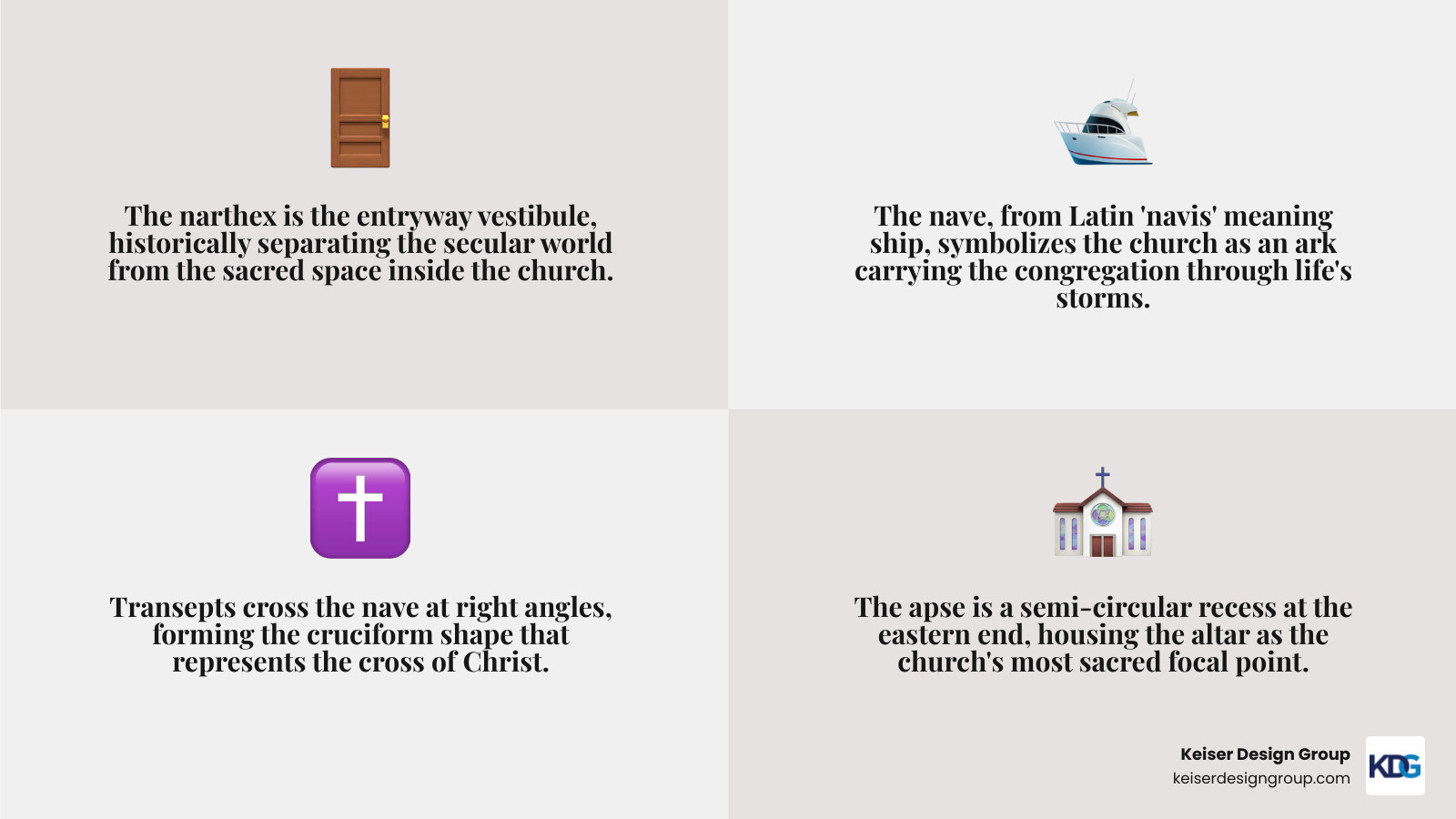
The narthex is the entry vestibule, one of the most overlooked parts of a church building, that bridges the exterior and the nave. Historically, it was a distinct area at the western end of the church, often separated from the main body by a screen or railing. In the early church, this space was reserved for those not yet eligible for full admittance into the congregation, such as the unbaptized or those undergoing penance.
Today, in our work across Ohio and the Midwest, we view the narthex as the vital “third space.” It is where the community greets one another, sheds the distractions of the outside world, and prepares for service. Whether it is a narrow vestibule in a historic chapel or a sprawling, sun-lit lobby in a modern facility, the narthex remains the crucial first impression of the building.
The Nave: The Heart of the Assembly
The nave is the central part of the church where the congregation sits or stands. Its name carries one of the most beautiful metaphors in ecclesiastical architecture: it is derived from the Latin word navis, meaning “ship.”
Early Christians viewed the church as an “Ark of Salvation,” much like Noah’s Ark, carrying the faithful through the turbulent seas of life. If you look up at the ceiling of many traditional naves, the exposed timber beams often resemble the hull of an overturned ship. While medieval churches were often long and narrow, many modern designs for congregations of 100 to 150 people utilize more “centripetal” or semi-circular layouts to bring everyone closer to the action.
The Sacred Core: Sanctuary, Chancel, and Altar
The sanctuary and chancel represent the liturgical center of the building, housing the most sacred elements of the worship service. This area is often elevated by a few steps to ensure visibility and to signify the importance of the rites performed there. In Architectural Design Churches, we focus on how this “Sacred Core” acts as the visual anchor for the entire room.
Defining the Sanctuary and Chancel
These parts of a church building are often used interchangeably, but they have distinct meanings. The chancel is the space around the altar, which historically included the choir and the sanctuary. The name comes from the Latin cancelli, meaning “lattice work,” referring to the screens that once separated the clergy from the laity.
The sanctuary is the specific area containing the altar—the “Holy of Holies.” In many traditions, this area was historically a place of legal protection or “sanctuary” for those seeking refuge. Today, we design these spaces to be open and accessible while maintaining a sense of reverence through lighting and material choices.
The Altar: The Focal Point Among Parts of a Church Building
The altar is the table where the central rites of the service, such as the Eucharist or Communion, take place. Traditionally made of stone, marble, or solid wood, the altar is meant to be a permanent, fixed fixture.
In some traditions, this is called the Communion Table. Regardless of the name, it is the primary focal point of the interior. We often see altars placed at the “liturgical east” end of the building, symbolizing the rising sun and the return of Christ. When renovating historic spaces, like our work at St. Paul’s Episcopal Church, we often find ways to restore these elements while improving the flow around them.
Structural Symbolism: Transepts, Apses, and Aisles
Church floor plans often utilize structural elements like transepts and apses to create a cruciform shape, which carries deep theological meaning while organizing the flow of people. These features allow for expanded seating and specialized ministry areas without losing the central focus of the sanctuary. We often discuss Mission Minded Worship Spaces with our clients to determine which layout best serves their specific outreach goals.
Transepts and the Cruciform Plan
A transept is the crosswise wing that intersects the nave, creating a cruciform (cross-shaped) plan. When a church has two transepts (one on the north and one on the south), the building takes on the shape of a cross when viewed from above. This is known as a cruciform plan.
The point where the transepts and the nave meet is called the “crossing.” In large cathedrals, this is often where you will find a massive tower or dome. This layout isn’t just symbolic; it provides practical space for side chapels, additional seating, or organ pipes, helping a large building feel more organized.
The Apse and Ambulatory
The apse is the semi-circular or polygonal termination of the main building, usually located behind the altar. It often features a domed or vaulted ceiling and provides a majestic backdrop for the service.
In larger churches or cathedrals, you might find an ambulatory. This is a covered walkway that wraps around the apse, allowing people to move behind the choir and sanctuary without disturbing the service. This was particularly useful in the Middle Ages for pilgrims visiting various “radiating chapels” located along the perimeter. We utilized similar concepts of flow in our Sycamore Creek Church Worship Addition to ensure that movement within the space felt natural and unobtrusive.
| Feature | Longitudinal (Cruciform) Plan | Centripetal (Modern) Plan |
|---|---|---|
| Shape | Cross-shaped; long and narrow | Square, circular, or fan-shaped |
| Focus | Distant focal point at the end | Centralized focus; intimate feel |
| Acoustics | High reverberation; traditional | Controlled; optimized for speech/modern music |
| Flexibility | Fixed pews; formal | Movable seating; multi-purpose |
Functional Features: From the Pulpit to the Baptismal Font
Liturgical furnishings are parts of a church building that support worship, especially the pulpit/ambo and the baptismal font. Modern design often prioritizes flexibility in these features to accommodate various worship styles and community events.
Ambo, Pulpit, and Lectern
While they all involve speaking, these parts of a church building have different historical uses. The pulpit is a small, elevated platform used specifically for delivering sermons. In 1603, they were actually made compulsory in English churches!
The ambo is a reading stand used in many traditions for the Gospel, Epistle, and homilies. Historically, some churches had two—one for the Gospel and one for the Epistle—but today, a single ambo is more common. A lectern is a simpler reading stand, often used for scripture readings by the laity. Fun fact: many traditional lecterns are shaped like an eagle with outstretched wings, symbolizing the Word of God soaring to the ends of the earth. In facilities like the Five14 Church Worship Facility, these elements are often designed to be movable to allow for different stage configurations.
The Baptismal Font and Sacristy
The baptismal font is the vessel used for the rite of baptism. Historically, these were placed near the main entrance of the church to symbolize that baptism is the “doorway” into the Christian life. In some historic contexts, baptismal fonts even had lockable lids to protect the water and vessels.
The sacristy (sometimes called the vestry) is a private room where the clergy prepares for the service. It houses sacred vessels, vestments, and parish records. A specialized sink called a sacrarium is often found here; it drains directly into the earth rather than the sewer system to ensure that any sacred substances are handled with dignity. We often emphasize the importance of these support spaces in Church Design Childrens Ministry planning, as they are essential for the smooth operation of Sunday morning logistics.
Exterior Anatomy: Facades, Steeples, and the Parts of a Church Building
The exterior of a church building acts as a landmark within the community, using features like steeples and ornate facades to signal its purpose and invite visitors inside. These elements combine aesthetic appeal with functional requirements. As an Architect for Churches, we know that the “curb appeal” of a church is the first step in a visitor’s journey.
The Facade and Portal
The facade is the front “face” of the building. It is usually the most decorated part of the exterior, designed to catch the eye of passersby. The main entrance is known as the portal.
In Gothic and Romanesque architecture, you will often see a tympanum—a decorative semi-circular or triangular wall surface over the door. These were frequently carved with scenes like “The Last Judgment” to prepare worshipers as they entered the sacred space. In modern design, we often use glass and open steelwork to create a sense of transparency and welcome.
Towers, Spires, and Other Parts of a Church Building
Few parts of a church building are as instantly recognizable as the steeple. This vertical element typically consists of a tower (the base) and a spire (the pointed top). The word “spire” actually comes from an Old English word for a tall blade of grass!
These structures served two main purposes: they acted as a beacon to guide people to the church, and they housed the belfry or bell tower. Before the age of digital notifications, bells were the primary way to call the community to worship or signal important events. Whether your project involves a traditional masonry tower or a contemporary steel spire, these elements provide a sense of verticality that points toward the heavens.
Frequently Asked Questions about Church Architecture
What is the difference between a narthex and a vestibule?
The narthex is a specific type of vestibule found in ecclesiastical architecture, historically serving as a space for those not yet admitted to the full congregation, whereas a vestibule is a general term for any entry hall or lobby. Think of the narthex as a “sacred lobby” with specific liturgical functions.
Why is the main seating area called a nave?
The term “nave” comes from the Latin word navis, meaning ship. This symbolizes the church as an “ark of salvation” that carries the faithful through the storms of life. Architecturally, the ceiling beams of many naves even look like the ribs of a ship’s hull.
What is the purpose of a transept in church design?
A transept is a transverse aisle that crosses the nave at a right angle, giving the building a cross-shaped (cruciform) layout. Beyond the symbolism of the cross, it provides practical space for additional seating, choirs, or side chapels, making it easier for large congregations to see and hear the service.
Conclusion
Understanding the various components of a worship space is essential for any building committee looking to renovate or build anew. From the welcoming narthex to the soaring steeple, every one of the parts of a church building plays a role in telling your congregation’s story and facilitating your mission.
At Keiser Design Group, we specialize in helping congregations navigate these architectural complexities. Whether you are inspired by the historic reorganization of the Centerburg Worship Facility or looking to create something entirely new, we offer a simple, worry-free process tailored to your unique vision.
If you are ready to start planning your next project, we would love to hear from you. Please contact Keiser Design Group today to schedule a consultation and see how we can bring your vision to life.