Why Building New Schools Is One of the Most Complex — and Important — Projects a Community Can Undertake
Building new schools is a multi-year process that involves funding approvals, site selection, community input, phased design, and careful construction management — all before a single student walks through the door.
Here is a quick overview of what the process involves:
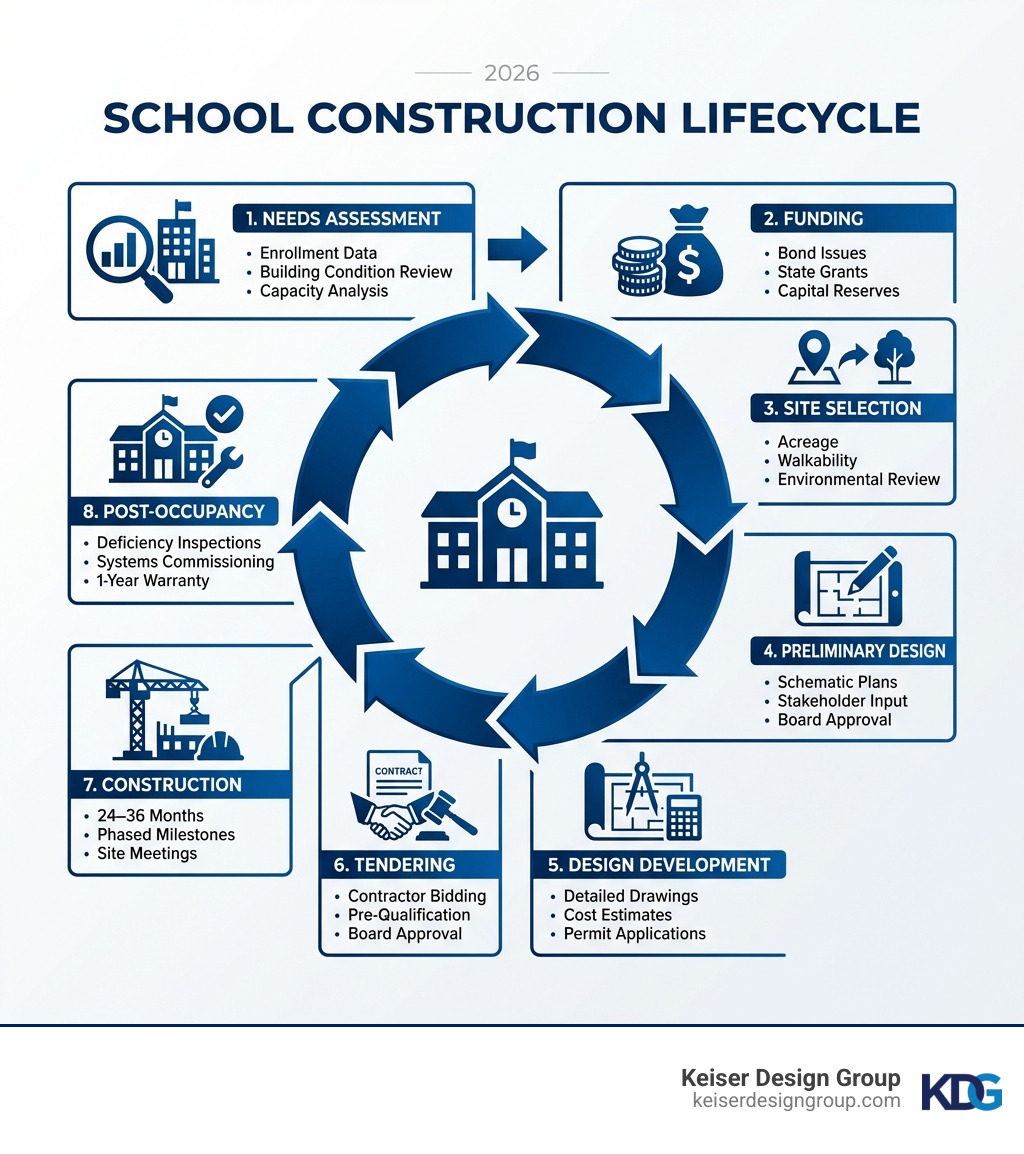
- Assess the need — Review enrollment trends, building conditions, and capacity pressures
- Secure funding — Pursue bond issues, state capital grants, or federal aid
- Select a site — Evaluate acreage, accessibility, environmental standards, and zoning
- Design the facility — Work through initial plans, detailed design, and construction documents
- Bid and build — Bid the project, select a contractor, and manage construction (typically 24–36 months)
- Final inspection — Conduct inspections, address deficiencies, and verify all building systems perform as designed
The need for building new schools is urgent in many growing districts. As of the 2023–24 school year, more than 1,450 schools across Ontario alone were overcapacity — a pattern reflected in communities throughout the United States as well. Aging infrastructure, growing enrollment, and deferred maintenance are pushing districts to act fast, but the process demands careful, strategic planning.
A rushed school project leads to costly mistakes. A well-planned one serves a community for generations.
I’m Dan Keiser, Founder and Principal Architect of Keiser Design Group, with nearly 30 years of experience guiding clients through complex projects — including building new schools and major educational facility renovations. I’ll walk you through everything you need to know to approach this process with confidence.
The Strategic Process of Building New Schools
Building new schools requires a multi-year commitment that balances community needs, enrollment projections, and long-term financial health. Successful projects begin with a comprehensive needs assessment to determine if a new build or a significant renovation is the most cost-effective solution for the district. We often see districts spend two full years in the assessment and planning phase before even applying for funding. This “pre-work” is essential to ensure the project aligns with the district’s educational philosophy and long-term goals.
Addressing Capacity Pressures by Building New Schools
Capacity pressure is the primary driver for building new schools in growing regions like Central Ohio and Indianapolis. When a school is projected to remain overutilized for a decade, and surrounding schools lack the space to absorb the overflow, a new facility becomes a necessity.
Utilization rates help us measure this pressure. A school is considered “overcapacity” once it exceeds 100% utilization of its permanent structures. While portables are often used as a stop-gap measure, they are intended to be temporary. Relying on portables for long-term capacity can lead to safety concerns and fragmented learning environments.
Evaluating the Infrastructure Backlog
When building new schools, the “state of good repair” becomes a critical metric. Many districts face a significant infrastructure backlog—deferred maintenance on HVAC systems, roofs, and windows that eventually makes renovation more expensive than replacement.
We use a building condition assessment to evaluate whether a building should be repaired or replaced. If the cost to bring a building to a state of good repair exceeds 65-80% of its replacement value, the strategic choice is almost always to build new. Aging facilities often lack the electrical and data infrastructure needed for modern 21st-century learning, making the transition to a new facility a transformative moment for both teachers and students.
Planning, Funding, and Site Selection
Securing funding for school construction typically involves a combination of local bond issues, state aid, and capital reserve funds. Once funding is secured, site selection must prioritize student safety, accessibility, and environmental impact to ensure the facility serves the community for decades. In our experience, districts that involve stakeholders early—including parents and local business owners—see much higher success rates during funding votes.
Navigating Bond Issues and State Funding
In the United States, particularly in Ohio, Indiana, and Kentucky, the most common path to building new schools is through a voter-approved bond issue. For example, the OHLSD Bond Issue for new schools represents a community-driven effort to fund three new facilities.
When preparing for a bond, we help districts develop “business cases” that clearly illustrate the need. This includes showing how current facilities are failing to meet educational standards and how the new design will provide a better return on investment for taxpayers. Some districts also utilize capital reserve funds—essentially a “pay-as-you-go” savings account—to accumulate funds over several years, reducing the total amount needed from interest-bearing bonds.
Site Selection and Environmental Standards
Selecting the right piece of land is just as important as the building design. For an elementary school, we typically look for a minimum of 20 acres, while high schools often require 30 acres or more to accommodate athletic fields and parking.
Accessibility and walkability are high priorities. Sites that allow students to walk or bike safely reduce transportation costs and environmental impact. Furthermore, many modern projects target LEED Silver or Platinum certification. These sustainable designs aren’t just good for the planet; they significantly reduce annual utility costs—sometimes by 10% or more—leaving more money in the district’s general fund for instruction. You can see how these standards are applied in real-time by following Akron school construction updates.
The Phased Approach to Construction
The construction of a new educational facility generally spans 24 to 36 months and is divided into distinct phases: initial design, detailed design, construction documents, bidding, construction, and final inspection. This structured approach ensures that every stakeholder, from school boards to community members, is aligned with the project’s progress. We believe in a “no-surprises” philosophy, where regular communication keeps the project on track and within budget.
Common Timelines for Building New Schools
While the physical construction might take two years, the design and approval process adds significant time. Site Plan Approval alone can take up to 18 months depending on local zoning and environmental regulations.
- Initial Design: Creating the “footprint” and basic layout based on educational requirements.
- Detailed Design: Refining the details, from mechanical systems to interior finishes.
- Construction Documents: Producing the technical blueprints used for bidding and permits.
- Bidding: Prequalifying contractors and selecting the best bid.
- Construction: The 24–36 month period where the vision becomes reality.
- Final Inspection: A one-year warranty period to ensure all systems perform as intended.
Managing Multi-Phase Renovations and Additions
Sometimes, the best strategy isn’t a brand-new campus, but a major addition or renovation of an existing site. These projects are often more complex because they must be completed while school remains in session.
We prioritize student safety by phasing construction to isolate heavy work and hazardous materials removal (like asbestos or lead) during summer breaks or off-hours. For example, in the Patriot Preparatory Academy project details, we managed a complex addition that modernized the academic environment without disrupting daily learning. This requires a construction feasibility review early in the design to minimize change orders and keep the project moving.
Modern Design Standards for Student Success
Modern school design focuses on creating flexible, high-performance environments that support diverse learning styles and prioritize student well-being. Incorporating elements like natural daylighting, advanced acoustics, and adaptable furniture can significantly improve educational outcomes and teacher retention. We don’t just build classrooms; we build “learning ecosystems.”
Flexible Spaces and Future-Ready Architecture
The days of “cells and bells”—identical classrooms lined up along a dark hallway—are over. Future-ready architecture emphasizes cross-subject learning, where science, technology, and art can overlap in shared “maker spaces.”
Flexible zones and media centers are designed to be the “heart” of the school, offering spaces for both large-group collaboration and quiet, individual study. By using moveable walls and adaptable furniture, a single space can transition from a lecture hall to a collaborative workshop in minutes. To dive deeper into these trends, explore our guide on the future of education: new school designs.
Safety, Security, and Safety-Focused Design
Security is a top-of-mind concern for every parent and administrator we work with. We utilize safety-focused design principles to create a secure environment that still feels welcoming.
This includes “controlled access” points where all visitors must pass through a single, secure vestibule before entering the main building. We also incorporate stress-reducing design, using soft colors, natural light, and clear sightlines to reduce anxiety and foster a sense of safety. A secure school entrance shouldn’t look like a fortress; it should look like a gateway to opportunity.
Frequently Asked Questions about School Construction
How long does it take to build a new school?
From the initial needs assessment to the first day of school, the process typically takes 5 to 10 years. The actual construction phase usually lasts 24 to 36 months, but the planning, site selection, and funding approvals often take several years of preparation.
What is the difference between renovation and a new build?
A renovation updates an existing structure, which can be more sustainable and preserve community history. However, if a building’s systems (HVAC, plumbing, electrical) are failing or the layout cannot support modern technology, building new schools is often more cost-effective over the long term.
How are school construction projects funded?
In our regions of Ohio, Indiana, and Kentucky, funding most often comes from local property tax levies and bond issues. Some states also provide matching grants or aid based on the district’s wealth and the urgency of the facility’s condition.
Conclusion
Building a new school is a transformative investment in a community’s future that requires expert guidance and a tailored approach. It is about more than just bricks and mortar; it is about creating a space where the next generation can thrive. At Keiser Design Group, we provide school districts with comprehensive architectural services and a simple, worry-free process to turn educational visions into reality.
Whether you are facing rapid enrollment growth or an aging infrastructure backlog, we are here to help you navigate every phase of the journey. Contact Keiser Design Group today to connect with our team and move forward with confidence.
Explore our school design services to see how we can support your district’s goals.