What You Need to Know About Tennessee Architecture
Tennessee Architecture spans a rich mix of historic preservation, modern commercial development, and nationally accredited design education — all governed by a well-established regulatory framework.
Here’s a quick overview of the regulations, education, organizations, and design traditions that define Tennessee Architecture:
| Topic | Key Facts |
|---|---|
| Regulatory Body | Tennessee Board of Architectural and Engineering Examiners (est. 1921) |
| Firm Licensing | No firm license issued; Corporation, Partnership, and Firm Disclosure form required |
| Individual Licensure | NAAB-accredited degree + AXP + ARE exam required |
| Continuing Education | 24 PDH every two years; no carryover since January 1, 2023 |
| Top Education | University of Tennessee, Knoxville — NAAB-accredited B.Arch and M.Arch programs |
| Professional Advocacy | AIA Tennessee represents 1,600+ members statewide |
| State Oversight | Office of the State Architect manages state-funded capital projects |
Whether you are planning a renovation, evaluating a development opportunity, or researching Tennessee Architecture, this guide explains the standards and professional services that shape projects across the state.
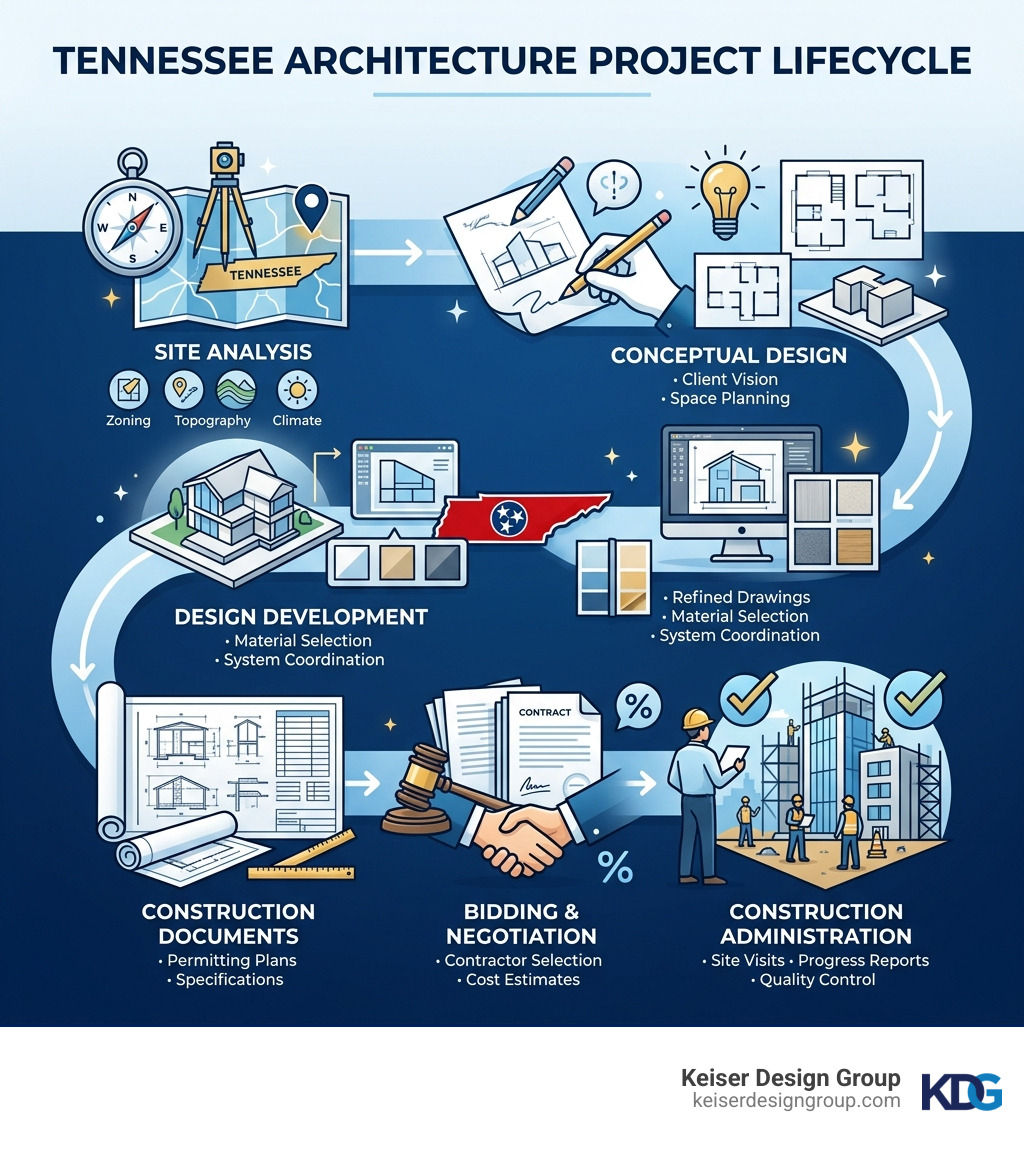
I’m Dan Keiser, founder and principal architect of Keiser Design Group, with over three decades of hands-on experience leading projects from initial concept through construction administration across the region — including work closely aligned with the regulatory and design standards that define Tennessee Architecture. That depth of experience shapes everything we share in this guide.
The Regulatory Landscape of Tennessee Architecture
In the Volunteer State, the practice of architecture is not just about aesthetics; it is a strictly regulated profession designed to protect the public. Tennessee Architecture is governed by the Tennessee Board of Architectural and Engineering Examiners. Established in 1921, the Board has more than a century of experience regulating Tennessee’s built-environment professions.
The Board’s mission is simple but vital: to safeguard life, health, and property. The Board establishes registration and professional-conduct requirements intended to ensure that architects meet applicable education, experience, examination, and ethical standards. For clients, this means peace of mind knowing that their projects are being handled by professionals held to high legal and ethical standards.
The Office of the State Architect also plays an important role in Tennessee Architecture by supporting oversight, designer selection, and standards for state capital projects. They provide oversight for everything from the State Capitol to major university buildings, ensuring that public funds are used for high-quality, durable architecture.
Licensing Requirements for Tennessee Architecture Professionals
Becoming a registered architect in Tennessee generally involves three core components: education, documented experience, and examination.
- Education: Aspiring architects must typically earn a degree from a program accredited by the National Architectural Accrediting Board (NAAB).
- Experience: Candidates must complete the Architectural Experience Program (AXP), which involves thousands of hours of documented work under the supervision of a licensed professional.
- Examination: Finally, they must pass the rigorous Architect Registration Examination (ARE).
Architects registered in another jurisdiction may apply for Tennessee registration by comity, subject to the Board’s current education, experience, examination, and documentation requirements. An NCARB record may help provide transcripts, references, and verification records, but applicants must still complete the Tennessee application and satisfy the Board’s requirements.
Once licensed, the learning doesn’t stop. Tennessee requires architects to complete 24 Professional Development Hours (PDH) every two years to keep their license active. Architects renewing after their initial registration period must complete 24 Professional Development Hours during each two-year renewal cycle, with all required hours addressing health, safety, and welfare subjects. If you earn 30 hours in one period, those extra six hours cannot be applied to the next renewal. It’s a “use it or lose it” system designed to keep professionals current with the latest building technologies and safety codes.
Firm Disclosure and Compliance
A unique quirk of Tennessee Architecture is how firms are handled. Unlike some states that issue a specific “firm license,” Tennessee requires a Corporation, Partnership, and Firm Disclosure. The disclosure is mandatory for applicable firms and identifies the licensed professional responsible for the firm’s Tennessee architectural practice.
The core of this disclosure is identifying the person in “Responsible Charge.” This must be a Tennessee-licensed architect who has the authority to make all technical and design decisions for the firm’s projects in the state. This ensures that even if a large corporation is handling a project, there is a specific, qualified individual legally accountable for the work. Clients evaluating Tennessee architecture firms should verify that the firm has completed all applicable state disclosures and has an actively registered architect in responsible charge.
Architectural Education and Accreditation in Tennessee
Tennessee Architecture is also supported by several accredited professional degree programs across the state. Accredited programs are the gold standard because they ensure students meet the national requirements for licensure.
The University of Tennessee, Knoxville offers NAAB-accredited Bachelor of Architecture and Master of Architecture programs, while other Tennessee institutions also provide accredited professional architecture degrees. Founded in 1965 as the “New School of Architecture,” it has grown into the College of Architecture + Design. UT Knoxville offers an accredited five-year Bachelor of Architecture requiring 163 semester credit hours, along with accredited Master of Architecture pathways.
Pursuing a Degree in Tennessee Architecture
Getting into these programs is competitive. For example, at UTK, prospective students are often encouraged to submit a portfolio that showcases their visual thinking. Depending on the applicant pathway, admissions materials may include a portfolio that demonstrates spatial thinking, creativity, design judgment, and readiness for architectural study.
The curriculum is studio-heavy, meaning students spend a significant amount of time in “the shop” or at their desks, working through design problems. It’s a culture of “making.” Through studio-based learning and fabrication facilities, students studying Tennessee Architecture learn to balance creative exploration with technical design knowledge.
Specialized Programs and Research
Modern architecture is rarely just about the building itself; it’s about how that building sits in the landscape and serves its occupants through professional design. Tennessee programs have expanded to include:
- Landscape Architecture: Established at UTK in 2008, focusing on the unique topography of the Appalachian region and its integration with professional architectural design.
- Architectural Research: Focusing on the structural and spatial integrity of buildings to ensure they are as well-designed as the exterior.
- Advanced Fabrication: Utilizing high-tech facilities to bridge the gap between digital models and physical structures through professional expertise.
Research in these schools often touches on vital social issues, such as “Design for Aging,” which looks at how our homes and cities can better serve an aging population. This academic rigor ensures that when these graduates enter the workforce, they aren’t just drawing lines; they are solving complex human problems through professional architectural services. This combination of research, fabrication, and human-centered design prepares graduates to address practical challenges across residential, commercial, institutional, and public architecture.
Notable Styles and Historic Preservation
Tennessee is a state that remembers its history. From the grand Neoclassical “Parthenon” in Nashville to the humble but iconic dogtrot cabins of the rural countryside, Tennessee Architecture is a story of evolution.
Historic preservation is an important component of Tennessee Architecture, particularly in communities balancing redevelopment with the protection of culturally significant buildings. Professionals have documented thousands of buildings across the state—from the 1954 Ranches in Madison to the industrial structures of East Tennessee. Preserving these buildings requires knowledge of local building traditions, existing materials, rehabilitation standards, and applicable historic-preservation guidance. It’s about maintaining the soul of a city while making it functional for 2026 and beyond.
Modern Innovations in the Volunteer State
While we love our history, Tennessee is also booming with modern growth. Today’s design trends focus heavily on “adaptive reuse”—taking an old warehouse or a 1920s hotel and turning it into a boutique lifestyle space.
In urban centers like Nashville and Knoxville, we see a push for high-performance building materials and sustainable design. Across Tennessee, contemporary projects increasingly combine high-performance materials, energy-conscious design, natural light, and connections between indoor and outdoor spaces. Contemporary Tennessee homes and offices are increasingly designed to be “felt as much as seen,” prioritizing natural light and a seamless connection between indoor and outdoor spaces.
Professional Advocacy and State Resources
Architects in Tennessee don’t work in a vacuum. They are supported by a strong network of professional organizations and state resources that help navigate the complexities of the industry.
AIA Tennessee is the leading voice for the profession, representing over 1,600 members. They handle everything from disaster assistance (like after Hurricane Helene) to legislative advocacy. They ensure that the voices of architects are heard when new building codes or zoning laws are being debated. AIA Tennessee provides members with professional education, advocacy, industry resources, and connections to current issues affecting architectural practice.
Navigating State Projects and Commissions
If you are involved in a project funded by the state, you’ll likely encounter the State Building Commission (SBC). This body oversees the procurement process for designers and contractors on state-funded capital projects.
The process is rigorous and relies on “Qualification Based Selection” (QBS). Qualification-Based Selection evaluates architects according to factors such as professional expertise, relevant experience, project understanding, and past performance. This ensures that public projects—like schools, libraries, and state offices—are designed for longevity and quality. For Nashville Architects looking to do state work, registration with the OSA is a must.
Frequently Asked Questions about Tennessee Architecture
Does Tennessee require a separate license for architecture firms?
Tennessee does not issue a specific “firm license,” but it requires all architectural firms to file a “Corporation, Partnership, and Firm Disclosure” form with the Board. This ensures that a licensed architect is in “responsible charge” of all architectural work performed by the entity. The disclosure must be updated when specified firm information or responsible-charge leadership changes.
What are the continuing education requirements for architects in Tennessee?
Architects licensed in Tennessee must complete 24 Professional Development Hours (PDH) every two years. It is critical to note that as of January 1, 2023, the state no longer allows the carryover of excess PDH hours from one renewal period to the next. All hours must be earned within the current biennial period to count toward renewal.
Which universities in Tennessee offer accredited architecture degrees?
NAAB-accredited programs in Tennessee include professional architecture degrees at the University of Tennessee, Knoxville, the University of Memphis, and Belmont University. These programs are highly regarded for their “culture of making” and extensive fabrication facilities, such as the 20,000-square-foot Fab Lab in downtown Knoxville.
Conclusion
At Keiser Design Group, we bring a sophisticated, client-centered approach to every project, ensuring that your vision is translated into a functional, beautiful reality. Whether you are navigating the complexities of Tennessee Architecture or looking for a partner in the surrounding regions, our team provides the professional architectural services and strategic oversight necessary for success. Our simple, transparent design process removes the stress from construction, allowing you to focus on your goals.
Planning a residential, commercial, school, or mission-driven project in Tennessee? Contact Keiser Design Group to discuss your goals and learn how our collaborative architectural process can guide your project from early planning through construction.