Understanding Two Defining Styles of American Modernism
Art deco and streamline moderne are two closely related but distinct architectural styles that shaped the American landscape from the 1920s through the 1940s. Though often confused, they represent different responses to their times.
Quick Comparison:
| Art Deco (1920s-1930s) | Streamline Moderne (1930s-1940s) |
|---|---|
| Vertical emphasis with towers and setbacks | Horizontal emphasis with long, low lines |
| Rich ornamentation: zigzags, chevrons, sunbursts | Minimal decoration; smooth, unadorned surfaces |
| Sharp angles and geometric patterns | Curved corners and aerodynamic shapes |
| Exotic materials: lacquer, ivory, rare woods | Industrial materials: chrome, glass block, steel |
| Reflects 1920s prosperity and glamour | Reflects 1930s efficiency and forward motion |
Art Deco emerged first, celebrating the optimism and wealth of the Roaring Twenties with lavish geometric decoration and vertical drama. Streamline Moderne followed in the 1930s as the Great Depression demanded a more economical approach, stripping away ornament in favor of sleek, machine-inspired curves and horizontal lines that suggested speed and progress.
Both styles broke from traditional revivalist architecture, embracing modern materials and the machine age. Art Deco drew inspiration from ancient civilizations, Cubism, and the 1925 Paris Exposition. Streamline Moderne took cues from aerodynamics, ocean liners, and the practical efficiency championed by industrial designers.
I’m Dan Keiser, founder of Keiser Design Group, and throughout my three decades of architectural practice in Columbus, I’ve studied how art deco and streamline moderne principles can inform contemporary design that honors the past while meeting modern needs. Whether you’re renovating a historic property or seeking to incorporate these timeless aesthetics into a new build, understanding the distinction between these styles is the first step toward making informed design decisions.
The Roaring Twenties: Defining Art Deco’s Opulence
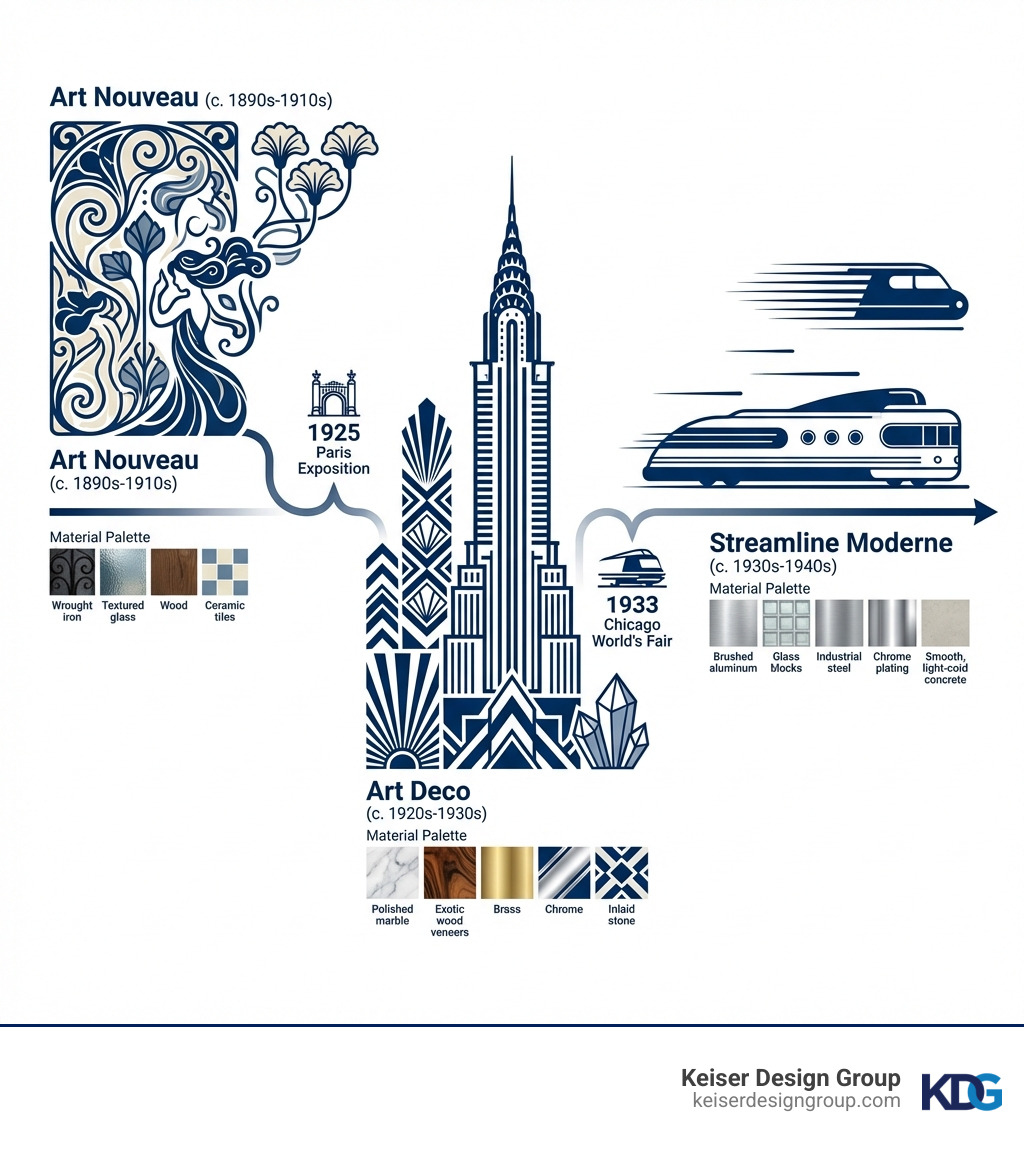
Art Deco is a style of modern architecture and design that became popular in the 1920s, defined by its luxuriousness, bold geometric forms, and celebration of the machine age. It represented the glamour and optimism of the post-WWI era, drawing inspiration from global cultures and new technologies to create a distinctly modern, yet highly decorative, aesthetic. This period, often called the “Roaring Twenties,” was marked by a sense of liberation and progress, and Art Deco perfectly captured this spirit. It was the first widely popular style in the U.S. to break with revivalist traditions, ushering in a new era of modern design.
The Key Characteristics of Art Deco
Art Deco architecture is instantly recognizable by its emphasis on verticality and its distinctive, often lavish, ornamentation. Buildings commonly feature smooth wall surfaces, frequently stucco or smooth-faced stone, which provide a sleek backdrop for intricate detailing. The style is characterized by:
- Vertical Emphasis: This is a hallmark, often achieved through soaring towers, vertical projections above rooflines, and a general upward thrust in design. Skyscrapers, in particular, embraced this vertical sleekness.
- Geometric Patterns: Expect to see sharp angles, zig-zags, chevrons, lozenges (diamond shapes), and parallel straight lines. These patterns often create a sense of movement and dynamism.
- Stylized Motifs: Ornamentation frequently includes stylized forms from nature (like sunbursts and floral designs), human figures, and animals, all rendered in a simplified, geometric manner.
- Rich Colors and Materials: Polychromy with vivid colors was common, especially in interior design and decorative arts. The style often incorporated varied, sometimes expensive, materials, including manufactured substances like Bakelite, along with traditional elements like stone, brick, and metal.
- Stepped-Back Facades and Ziggurats: Inspired by ancient Mesopotamian and Mesoamerican pyramids, these tiered designs not only created dramatic silhouettes but also complied with zoning laws in cities like New York, which required buildings to recede as they rose.

Inspirations and Historical Context
The origins of Art Deco are deeply rooted in the cultural and technological shifts of the early 20th century. Its formal debut and name are often traced back to the Exposition Internationale des Arts Décoratifs et Industriels Modernes held in Paris in 1925. This exposition showcased French luxury goods and modern decorative arts, setting the stage for the style’s international spread.
Key influences and contextual factors include:
- Reaction Against Art Nouveau: Art Deco emerged as a clear departure from the organic, flowing lines of Art Nouveau, favoring instead a more structured, geometric aesthetic.
- Machine Age and Technology: The optimism of the Roaring Twenties embraced industrial progress. Aviation, automobiles, and other new technologies inspired the sleek, aerodynamic forms and the sense of speed and modernity seen in Art Deco.
- Ancient Civilizations: Archaeological discoveries, particularly the excavation of Tutankhamun’s tomb in 1922, sparked a widespread fascination with ancient Egypt, leading to motifs like lotus flowers, scarabs, and pyramid shapes. Pre-Columbian art also provided inspiration for geometric patterns.
- Avant-Garde Art Movements: Art Deco incorporated elements from contemporary art movements such as Cubism (for its fragmented, geometric forms) and Futurism (for its emphasis on dynamism and speed).
- Prosperity of the Roaring Twenties: The economic boom following World War I fueled a demand for luxury and novelty, allowing for the use of opulent materials and intricate craftsmanship characteristic of early Art Deco.
The Shift to Sleek: How Streamline Moderne Responded to a New Era
Streamline Moderne, also called Art Moderne, is a later phase of Art Deco that emerged in the United States during the early 1930s as a direct response to the Great Depression. It stripped away the lavish ornamentation of early Art Deco, prioritizing a more functional, economical, and aerodynamic aesthetic. This shift reflected a society struggling with economic austerity, where efficiency and forward-looking optimism, rather than opulent display, became paramount. The style was heavily influenced by the scientific principles of streamlining in transportation, seeking to convey speed and progress through design.
The Defining Features of Streamline Moderne
In contrast to the verticality and rich detail of early Art Deco, Streamline Moderne emphasized fluidity, horizontality, and simplicity. Its defining characteristics include:
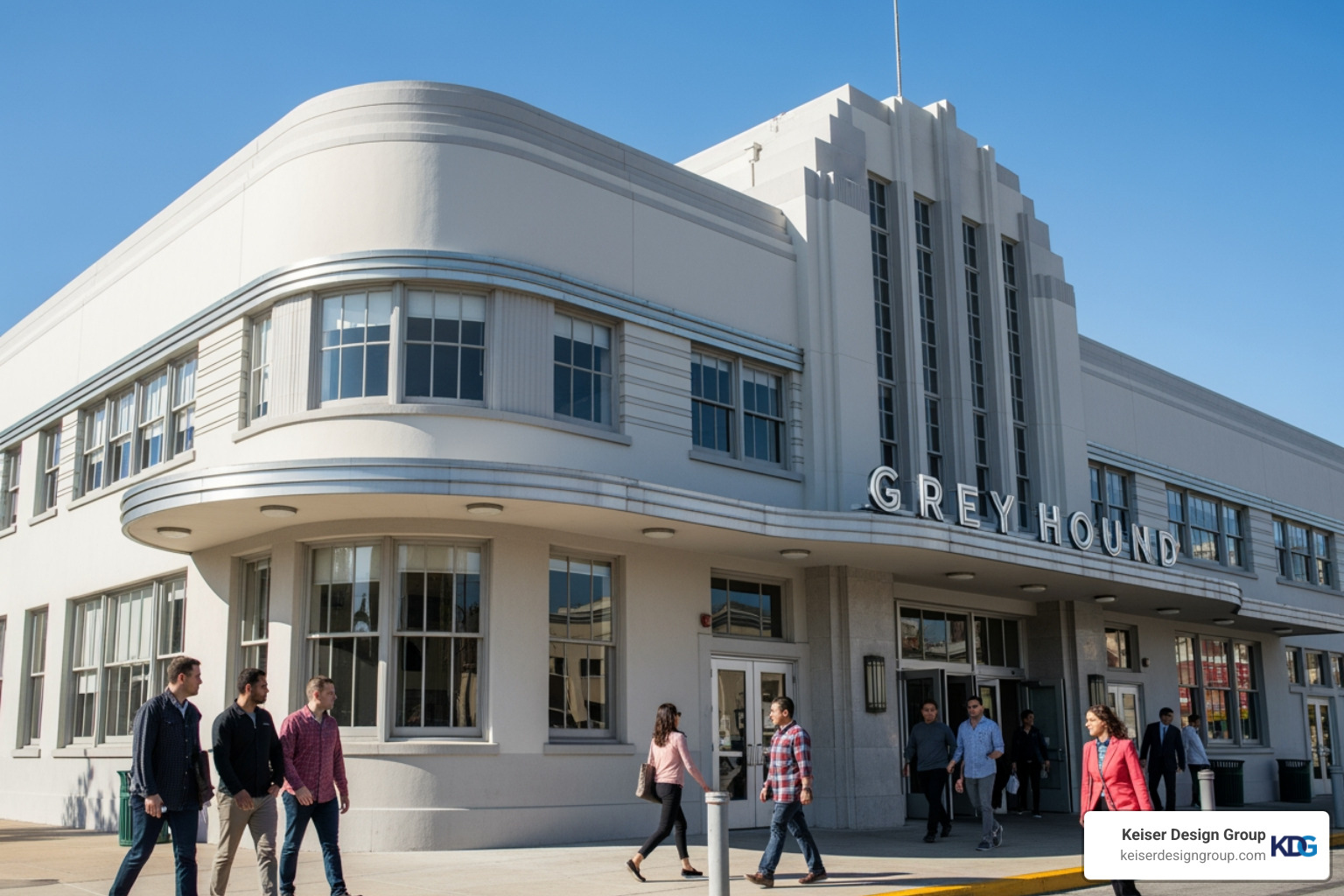
- Horizontal Emphasis: This is a key differentiator, with long, low lines, horizontal grooves, or “speed lines” in walls creating a sense of movement and breadth.
- Aerodynamic Curves and Rounded Corners: Inspired by the design of ships, trains, and planes, buildings often feature smooth, rounded walls and corners, giving them an aerodynamic, almost nautical appearance.
- Smooth, Unadorned Surfaces: Ornamentation is minimal or entirely absent, favoring sleek, smooth finishes, typically stucco, to emphasize form and line.
- Glass Block: A popular material, glass block walls were often used for their translucent qualities, allowing light while maintaining privacy, and contributing to the smooth, industrial aesthetic.
- Porthole Windows: Circular windows, reminiscent of ship portholes, were a common motif, reinforcing the nautical influence.
- Chrome Hardware: Polished chrome was frequently used for railings, door handles, and other fixtures, adding a touch of modern sheen.
- Flat Roofs: Buildings typically have flat roofs, often with small ledges, contributing to the clean, horizontal profile.
For a deeper dive into examples of this style in our region, you can explore many Ohio Art Deco & Streamline Moderne Buildings.
The Great Depression’s Impact on Design
The economic downturn of the Great Depression dramatically altered design sensibilities. The opulent, handcrafted luxury of early Art Deco became unsustainable and, in some cases, socially inappropriate. Streamline Moderne emerged as a pragmatic and optimistic alternative, embodying the era’s need for efficiency, affordability, and a hopeful vision for the future.
- Economic Austerity: The need for cost-effective solutions led to simpler forms and less expensive, mass-produced materials. This shift meant a focus on function over excessive ornamentation.
- Function Over Form: While aesthetics remained important, the underlying philosophy leaned towards practical utility. Designs were pared down to their essential elements.
- Mass Production and Affordability: The style lent itself well to mass production, making modern design accessible to a broader public. Industrial designers played a crucial role in applying streamlined aesthetics to everyday objects.
- Efficiency: The sleek, aerodynamic forms were meant to symbolize efficiency and speed, even if they didn’t always translate into actual aerodynamic performance in static buildings.
- Influence of the Bauhaus School: While distinct, the European Bauhaus school’s emphasis on functionalism and minimal ornamentation resonated with the practical spirit of Streamline Moderne, albeit without the same degree of decorative abstraction.
- World’s Fairs: Major expositions like the Chicago World’s Fair in 1933 (“A Century of Progress”) and the New York World’s Fair in 1939 (“The World of Tomorrow”) were instrumental in promoting Streamline Moderne. These fairs showcased modern living and design, featuring many buildings and exhibits in the new aesthetic, solidifying its public appeal.
A Visual Guide to Art Deco and Streamline Moderne
The easiest way to distinguish between Art Deco and Streamline Moderne is to look at their core visual themes: Art Deco is vertical, decorative, and sharp-angled, while Streamline Moderne is horizontal, simple, and curved. Though they are related, their expressions reflect the different economic and cultural moods of the decades in which they flourished. Art Deco celebrated post-WWI prosperity, while Streamline Moderne emerged as a hopeful, efficient response to the Great Depression.
Comparing the Hallmarks of Art Deco and Streamline Moderne
To truly appreciate the nuances, let’s break down the key differences:
| Attribute | Art Deco (1920s-early 1930s) | Streamline Moderne (mid-1930s-1940s) |
|---|---|---|
| Emphasis | Verticality, towering forms, setbacks | Horizontality, long lines, low-slung profiles |
| Shape | Angular, geometric, rectilinear, sharp edges | Curved, aerodynamic, rounded corners, smooth, flowing forms |
| Ornament | Lavish, stylized, geometric patterns (zigzags, chevrons), sunbursts, exotic motifs | Minimal, functional, often limited to “speed lines” or subtle banding |
| Materials | Exotic woods, lacquer, polished stone, bronze, chrome, glass, Bakelite, ornate metals | Chrome, stainless steel, glass block, concrete, stucco, Vitrolite, terrazzo, often simpler |
| Mood | Opulent, grand, luxurious, celebratory, optimistic, modern glamour | Efficient, functional, forward-looking, industrial, sleek, modern simplicity |
| Influences | Ancient civilizations, Cubism, Fauvism, Ballets Russes, Machine Age | Aerodynamics, ocean liners, trains, automobiles, industrial design |
| Typical Use | Skyscrapers, public buildings, luxury hotels, theaters, grand residences | Transportation hubs (bus/train stations), diners, roadside architecture, factories, some residential |
Understanding the Materials and Motifs
Both styles, while distinct, shared an embrace of new and modern materials, moving away from traditional building techniques.
Art Deco materials often reflected the luxury and technological optimism of its era. We saw a widespread use of:
- Manufactured Materials: Plastics like Bakelite and Vitrolite (a structural colored glass), along with aluminum and stainless steel, were celebrated for their modernity.
- Exotic and Polished Surfaces: Lacquer, highly polished wood veneers (like zebrawood or ebony), marble, and polished stone added to the luxurious feel.
- Decorative Metals: Chrome and bronze were frequently used for detailing, grilles, and ornamentation.
Streamline Moderne materials leaned towards practicality and industrial sleekness, often due to economic necessity during the Depression:
- Chrome and Stainless Steel: These metals were prominent for their durability, shine, and association with modern machinery.
- Glass Block: Valued for diffusing light and creating curved walls, it contributed to the style’s smooth, monolithic appearance.
- Stucco and Concrete: These materials allowed for the creation of smooth, curved, unadorned surfaces that were cost-effective.
- Terrazzo Floors: Durable and decorative, terrazzo became a popular choice for public spaces, often featuring geometric patterns.
In terms of motifs, Art Deco was rich with stylized sunbursts, chevrons, and animal forms. Streamline Moderne, while less ornate, often incorporated nautical motifs (porthole windows, ship-like railings) and speed lines—horizontal bands or grooves that visually suggested motion and efficiency.
Notable Buildings in Ohio and the Midwest
Our region boasts several magnificent examples of both Art Deco and Streamline Moderne architecture, showcasing how these styles were adapted and embraced in the heartland.
-
Cincinnati Union Terminal (Cincinnati, OH): This iconic structure stands as a testament to the grandeur of Art Deco, with its monumental half-dome entrance, intricate mosaic murals, and striking vertical elements. It seamlessly blends the decorative flourishes of Art Deco with an early sense of streamlining in its overall massing.
-
Carew Tower (Cincinnati, OH): An outstanding example of American Art Deco, the Carew Tower complex, completed in 1930, features a distinctive crown, ornate detailing, and a strong vertical emphasis that defines the Cincinnati skyline.
-
Cleveland’s Greyhound Bus Station (Cleveland, OH): A quintessential Streamline Moderne design, this building, opened in 1948, perfectly embodies the style’s aerodynamic aesthetic with its curved facade, horizontal banding, and smooth surfaces. It’s a prime example of how transportation buildings adopted this forward-looking style. You can learn more about its historical significance at Cleveland’s Greyhound Bus station.
-
Ohio Judicial Center (Columbus, OH): Originally the Ohio Supreme Court Building, this structure showcases strong Art Deco elements in its design, particularly in its relief sculptures, geometric patterns, and imposing presence.
-
Times-Star Building (Cincinnati, OH): Another Cincinnati gem, this building exhibits classic Art Deco characteristics with its vertical lines, setbacks, and decorative stone carvings.
-
Butler House (Columbus, IN): Built from 1934-1936, this residence is a true pioneer of the Streamline Moderne style, packed with the latest technology of its time and showcasing the smooth, curved forms typical of the era.
-
Greyhound Bus Terminal (Evansville, IN): This is another excellent example of Streamline Moderne in our service area, featuring the signature horizontal lines and rounded corners that defined the aesthetic of modern transportation.
-
Residential Examples in Columbus Suburbs: While less common for grand single-family homes, elements of Art Deco and Streamline Moderne found their way into smaller residential buildings and apartment complexes, particularly in the older suburbs of Columbus, Ohio, and surrounding areas, offering a touch of modern flair to domestic architecture.
These structures demonstrate our region’s rich architectural heritage and the lasting impact of Art Deco and Streamline Moderne. When considering a renovation or new build, understanding these historical styles can provide a unique foundation for design. For more on how we approach preserving and updating architectural styles, consider exploring our services.
The Enduring Legacy in Modern Design and Renovation
The influence of Art Deco and Streamline Moderne extends far beyond the 1940s, with their principles of bold forms and clean lines inspiring contemporary architects and designers. These styles are frequently revived in new construction and are a popular focus for historic renovation projects, offering a timeless blend of classic elegance and modern appeal. The resurgence of interest in these styles, particularly since the late 1960s, highlights their enduring aesthetic power and ability to evoke a sense of glamour, progress, and sophistication.
Incorporating Deco and Moderne Elements Today
For modern projects, the principles of Art Deco and Streamline Moderne offer a rich vocabulary for design:
- Neo-Art Deco: Contemporary applications often take inspiration from the geometric patterns, verticality, and luxurious materials of original Art Deco, adapting them to modern construction techniques and sensibilities. This might manifest in a new building’s facade, intricate metalwork, or a dramatic entryway.
- Contemporary Applications: The sleekness and emphasis on clean lines from Streamline Moderne are particularly relevant in contemporary interior design, where minimalism and functionality are highly valued.
- Interior Design: We often see Art Deco’s bold geometry and rich materials, or Streamline Moderne’s smooth curves and industrial chic, influencing furniture, lighting fixtures, and hardware in modern spaces. Imagine a dramatic Art Deco chandelier in a grand foyer or sleek, chrome-accented furniture in a living room.
- Renovating Historic Properties: For homeowners and businesses in Ohio, Indiana, and Kentucky with historic properties from these eras, renovation projects offer a chance to honor the original design while integrating modern amenities. Balancing preservation with contemporary needs means carefully restoring original features while subtly updating systems and layouts for 21st-century living. Our approach at Keiser Design Group focuses on maintaining the integrity of the original style while delivering custom, functional spaces.
The Lasting Influence on Industrial Design
The Streamline Moderne movement, in particular, had a profound and lasting impact on industrial design, shaping the look of everything from transportation to household appliances. Industrial designers of the era applied the principles of aerodynamics and efficiency to products, creating a distinctive aesthetic that symbolized modernity and progress.
- Streamlined Cars: Automobiles like the iconic 1934 Chrysler Airflow, with its aerodynamic body and integrated fenders, set a new standard for automotive design, influencing subsequent generations of cars.
- Trains and Ocean Liners: The design of high-speed trains (like the Pioneer Zephyr) and majestic ocean liners (such as the SS Normandie) showcased the epitome of streamlined aesthetics, inspiring architects to translate these forms into static buildings.
- Household Appliances: Everyday objects like toasters, vacuum cleaners, and radios were reimagined with smooth, curved forms, chrome accents, and minimal ornamentation, bringing the “machine age” aesthetic into homes across America. These designs made modern living both stylish and accessible.
Frequently Asked Questions about Art Deco and Streamline Moderne
What is the main difference between Art Deco and Streamline Moderne?
The primary difference lies in their emphasis and ornamentation. Art Deco (popular in the 1920s and early 1930s) emphasizes verticality, geometric patterns, and often rich, lavish, and stylized ornamentation. It reflects the optimism and prosperity of the post-WWI era. Streamline Moderne (popular from the mid-1930s into the 1940s) emphasizes horizontality, aerodynamic curves, and smooth, unadorned surfaces. It emerged during the Great Depression, prioritizing efficiency, functionality, and a forward-looking, machine-inspired aesthetic over opulence.
Can a building be both Art Deco and Streamline Moderne?
Yes, absolutely! Many buildings, especially those constructed during the transitional period of the early to mid-1930s, feature elements of both styles. Architects often blended the dramatic vertical massing, stepped-back forms, and geometric relief of Art Deco with the curved corners, horizontal “speed lines,” and smooth surfaces characteristic of Streamline Moderne. This hybridity is a fascinating aspect of the era’s architectural evolution. The Cincinnati Union Terminal is a fantastic local example that embodies elements of both.
Are these styles suitable for home design?
While most famously used for skyscrapers, public buildings, and commercial structures, both Art Deco and Streamline Moderne were adapted for residential architecture, particularly apartment buildings and some custom homes. Today, their principles are frequently incorporated into custom home designs and renovations to create unique and sophisticated living spaces. From dramatic, geometrically patterned entryways (Art Deco) to sleek, modern kitchens with curved islands and chrome accents (Streamline Moderne), these styles can provide a framework for a distinctive and stylish home.
Bringing Timeless Style to Your Modern Project
Understanding the nuances of Art Deco and Streamline Moderne reveals a story of adaptation, innovation, and enduring style. From the lavish details of the Roaring Twenties to the sleek optimism of the Machine Age, these architectural movements offer a rich source of inspiration for contemporary design. Whether you are looking to build a new home with classic elegance or restore a historic property to its former glory, the principles of these iconic styles can provide a framework for a truly distinctive project.
Choosing the right architect means finding a partner who not only appreciates this history but also knows how to translate it into a space that is both beautiful and perfectly suited to your modern life. The team at Keiser Design Group specializes in this synthesis, creating functional, beautiful designs that honor the past.
Contact us today to schedule a consultation and begin your architectural journey.