What Makes Cincinnati Architecture So Distinctive?
Cincinnati architecture is one of the most diverse and historically rich built environments in the American Midwest. From early Federal-style homes along the Ohio River to bold 21st-century landmarks designed by world-famous architects, the city’s buildings tell the story of over 200 years of growth, innovation, and reinvention.
Here are the most important things to know about Cincinnati’s architectural landscape:
- Oldest surviving styles: Federal and Greek Revival buildings in neighborhoods like Over-the-Rhine and the West End date back to the early 1800s
- Most iconic landmark: Cincinnati Music Hall, a Victorian Gothic masterpiece by Samuel Hannaford, completed in 1878
- Engineering first: The Ingalls Building (1903) is the world’s first reinforced concrete skyscraper, standing 15 stories tall
- Art Deco highlights: Carew Tower (49 stories, 574 feet) and Cincinnati Union Terminal (1933) are the city’s finest Art Deco structures
- Neighborhoods with the strongest architectural identity: Over-the-Rhine (Italianate), Clifton (Victorian estates), and Columbia-Tusculum (late Victorian)
- Modern standouts: Zaha Hadid’s Rosenthal Center for Contemporary Art, called by the New York Times “the most important American building completed since the end of the Cold War”
- Preservation leader: Cincinnati leads in adaptive reuse, with major renovations like the Music Hall restoration and the Cincinnati Union Terminal upgrade.
Whether you’re exploring the city’s rich past or its cutting-edge present, Cincinnati rewards anyone who looks up.
I’m Dan Keiser, Founder and Principal Architect of Keiser Design Group, and with over 30 years of experience guiding residential and commercial projects across Ohio and the surrounding region, I’ve developed a deep appreciation for the design principles that define Cincinnati architecture. That foundation shapes how I approach every project — blending historical context with practical, client-focused design.
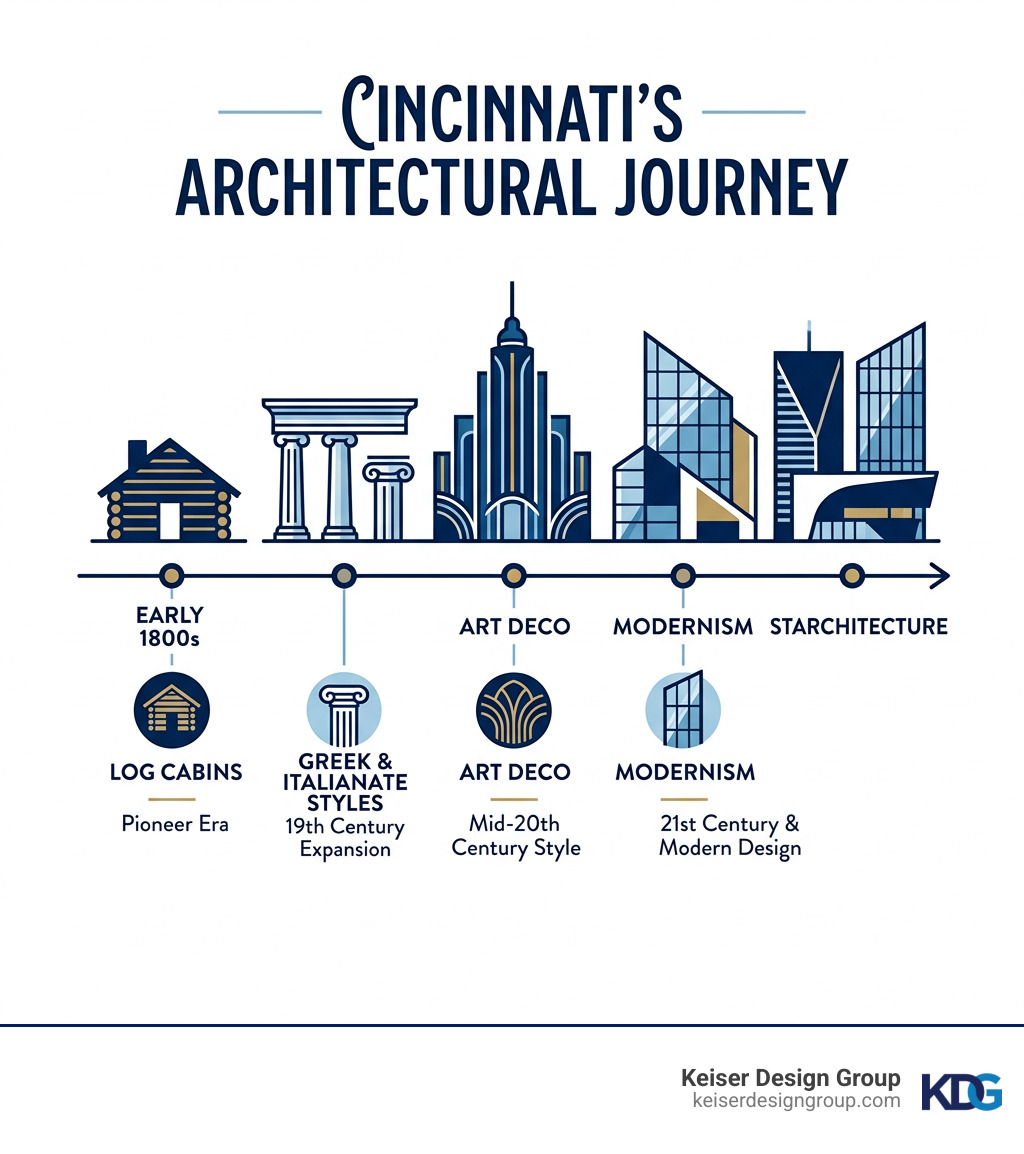
The Evolution of Cincinnati Architecture: From River Town to Modern Metropolis
The evolution of Cincinnati architecture is a direct reflection of American industrial and social progress. In the early 1800s, the city’s built environment consisted primarily of simple log cabins and wood-frame structures. However, as Cincinnati’s status as a major river commerce hub grew, so did the ambition of its buildings. By the 1850s, it was the fastest-growing city in the country, packing over 100,000 people into just seven square miles.
This density forced vertical growth and the adoption of durable materials. Local soil was ideal for brick manufacturing, which became the standard for early residential growth in the West End and Over-the-Rhine. As railroads expanded in the 1840s, architects gained access to imported marble and granite, allowing for more prestigious “high style” designs. This era saw the transition from Federal and Greek Revival styles to the ornate Italianate and Queen Anne periods, fueled by technological breakthroughs like the powered scroll saw and local cast-iron foundries.
The defining eras of Cincinnati’s architectural timeline include:
- Early Settlement (1788–1830s): Log cabins and Federal-style brick rows.
- The Greek & Gothic Revivals (1830s–1860s): Stately columns and pointed arches.
- The Italianate Boom (1860s–1890s): Ornate cornices and narrow, high-density brick buildings.
- The High Victorian & Romanesque Era (1870s–1900): Massive stone structures and intricate brickwork.
- The Art Deco & Modernist Rise (1920s–1960s): Sleek skyscrapers and reinforced concrete.
- Contemporary “Star-chitecture” (1990s–Present): Deconstructivist forms and glass-heavy facades.
To learn more about how we view these historical transitions in our modern work, see our Background & History: Cincinnati Architecture page.
Historical Landmarks and the Influence of Samuel Hannaford
No single individual left a larger mark on the city’s skyline than Samuel Hannaford. Active from 1858 to 1897, Hannaford was responsible for some of the city’s most enduring symbols. His most famous masterpiece is undoubtedly Cincinnati Music Hall. Built in the Venetian Gothic style, it stands as a “cathedral to the arts,” featuring music-themed sandstone carvings and a massive rose window.
Hannaford also designed Cincinnati City Hall (1888–1893), which remains the city’s best example of Richardsonian Romanesque architecture. The building uses “forced perspective”—an optical trick where windows get smaller toward the top—to make the four-and-a-half-story structure appear even more monumental. These landmarks were built with stone sourced from multiple states and marble from Italy, showcasing the city’s immense wealth during the late 19th century.
The Rise of Art Deco and the Iconic Carew Tower
As the 20th century dawned, Cincinnati architecture embraced the sleek, optimistic lines of Art Deco. The crown jewel of this movement is the Carew Tower. Completed in 1931 during the height of the Great Depression, this 49-story, 574-foot-tall skyscraper was a “city within a city,” housing offices, a hotel, and a retail arcade.
In Cincinnati architecture, the Carew Tower complex is world-renowned for its Art Deco interiors, specifically the Hilton Cincinnati Netherland Plaza, which features rare Brazilian rosewood and custom Rookwood Pottery tiles. Interestingly, the steel framework for the tower was raised at a world-record speed of 15,000 tons in just 61 days. Today, the building is transitioning again, with plans for a residential conversion that will bring new housing back into the tower. For those interested in this era, the List of Art Deco architecture in Ohio provides a broader look at the style’s regional impact.
Neighborhood Identities and Residential Styles
In Cincinnati, your neighborhood often dictates your architectural surroundings. The city’s unique geography—a basin surrounded by hills—allowed distinct identities to flourish. While the “East Side vs. West Side” divide is a common local talking point, the real story lies in the craftsmanship of the homes. From the worker cottages of the basin to the merchant mansions on the hills, residential design here is incredibly diverse.
Whether we are working on a historic renovation or a new build, we prioritize residential services that respect these established identities.
| Feature | OTR Italianate | Columbia-Tusculum Victorian |
|---|---|---|
| Primary Material | Red Brick | Wood Siding (Painted Ladies) |
| Common Detailing | Cast-iron cornices & corbeling | Gingerbread trim & turrets |
| Building Density | High (Row houses) | Moderate (Detached estates) |
| Era | 1860s – 1880s | 1870s – 1890s |
Over-the-Rhine and the Italianate Legacy
Over-the-Rhine is widely recognized for having one of the country’s largest collections of well-preserved Italianate buildings. This neighborhood was built primarily by German immigrants who favored high-density brick row houses with commercial storefronts on the ground floor. The style is defined by tall, narrow windows, decorative brick corbeling, and elaborate cast-iron cornices. In Cincinnati architecture, Over-the-Rhine’s revival shows how preservation and redevelopment can coexist.
Sears Kit Homes and Suburban Expansion
As transportation evolved from horsecars and inclines to the automobile, Cincinnati expanded into the suburbs. This era birthed a unique phenomenon: the kit home hotbed. Between 1908 and 1940, more than 1,000 Sears Kit Homes were built across the Greater Cincinnati area. These pre-cut homes were ordered from a catalog and shipped by rail. Cincinnati became a primary market for these because a Sears subsidiary, the Norwood Sash & Door Company, was located right in the city, making the distribution of these Bungalow, Colonial Revival, and Tudor-style homes incredibly efficient.
Engineering Marvels and Modern Cincinnati Architecture
Cincinnati has never been afraid of bold engineering. The city’s skyline is a conversation between the 19th-century industrial spirit and 21st-century “star-chitecture.” That spirit of experimentation is reinforced by the University of Cincinnati’s design culture, which continually adds new ideas to the city’s built environment.
The Roebling Bridge and Its Lasting Influence
The John A. Roebling Suspension Bridge, built in the mid-1800s, was one of the era’s most significant engineering achievements. Built between 1856 and 1866 at a cost of $1.8 million, it was the longest suspension bridge in the world at the time of its completion. It served as the engineering prototype for Roebling’s later project, the Brooklyn Bridge.
The bridge’s influence extends into the 21st century. Daniel Libeskind’s “The Ascent at Roebling’s Bridge,” completed in 2008, features a sweeping, crescent-shaped roofline designed specifically to mimic the cables and movement of the historic bridge. This project highlights how modern Cincinnati architecture can pay homage to the past without being trapped by it.
Contemporary Trends in Cincinnati Architecture
In Cincinnati architecture, contemporary design has included work by internationally recognized architects and institutions. Zaha Hadid’s Rosenthal Center for Contemporary Art (2003) was a turning point, described as a “vertical garden” that brings the sidewalk into the building.
Other contemporary highlights include FC Cincinnati’s TQL Stadium, Clifton Court Hall, and The Banks riverfront district.
Preservation and Adaptive Reuse in the Queen City
One of the most exciting aspects of Cincinnati architecture today is adaptive reuse. Rather than tearing down the past, the city is finding new current life for its historic anchors. We see this in projects like our own Maumee Bay Brewing Company work, where industrial history is preserved to create community-centric spaces.
Landmark Renovations and Structural Integrity
The city has committed hundreds of millions of dollars to preserve its heritage. Cincinnati Music Hall recently underwent a $143 million renovation, which included restoring the original brick facade and modernizing the acoustics while adding 30,000 square feet of functional space.
Similarly, the Ingalls Building—the world’s first reinforced concrete skyscraper—is a testament to structural integrity. Built in 1903, skeptics at the time predicted the 15-story building would collapse under its own weight. Instead, it helped prove reinforced concrete could support tall buildings—an important milestone in high-rise construction.
Urban Planning and the Impact of Infrastructure
In Cincinnati architecture, infrastructure decisions like I-71 and I-75 reshaped neighborhood connections and development patterns. This infrastructure created the modern “East Side” and “West Side” identities. At the center of it all remains Fountain Square, the city’s symbolic heart since 1871. The Tyler Davidson Fountain was donated by Henry Probasco to provide clean drinking water to the public, and its 2005 renovation ensured it remains the primary gathering place for the city’s major festivals and events.
Frequently Asked Questions about Cincinnati Architecture
What is the most iconic historical building in Cincinnati?
Cincinnati Music Hall is widely considered the city’s most iconic building. Designed by Samuel Hannaford in the High Victorian Gothic style, it is a National Historic Landmark. Its recent $143 million renovation preserved its signature red brick facade and intricate sandstone carvings while ensuring it remains a world-class venue for the symphony, opera, and ballet.
Why is Over-the-Rhine architecturally significant?
Over-the-Rhine contains the finest and largest concentration of intact Italianate architecture in the United States. This neighborhood reflects the dense urban development of the mid-to-late 19th century, characterized by brick row houses with ornate cornices and cast-iron storefronts. It serves as a premier example of how historic preservation can drive modern urban revitalization.
How did the Roebling Bridge influence the city’s skyline?
The Roebling Suspension Bridge served as a technological prototype for the Brooklyn Bridge and remains a focal point of the riverfront. It has influenced modern developments like The Ascent, whose twisting profile and sloped roof were designed by Daniel Libeskind to echo the bridge’s suspension cables, bridging the gap between 19th-century engineering and contemporary design.
What is the world’s first reinforced concrete skyscraper?
The Ingalls Building, located at 4th and Vine Streets, is the world’s first reinforced concrete skyscraper. Built in 1903, the 15-story structure proved that concrete could be used for tall buildings, a concept at the time that changed the course of global architecture.
Conclusion
The rich tapestry of Cincinnati architecture is more than just a collection of buildings; it is a legacy of innovation, resilience, and beauty. From the Victorian Gothic spires of Music Hall to the Art Deco elegance of Carew Tower, the city offers an unparalleled look at the evolution of the American built environment.
Understanding this history helps property owners plan renovations and new builds, and choose an Ohio architecture firm that respects local context. At Keiser Design Group, we bring an appreciation for tailored design and structural excellence to every client. Whether you are looking for Architect Firms in Columbus, Ohio, or planning a project in the Cincinnati area, our mission is to provide a simple, worry-free process that respects the past while building for the future.
Planning a renovation, adaptive reuse, or new build inspired by Cincinnati architecture? We’d love to come alongside you with a clear, client-focused process shaped by decades of work across Ohio. Contact us today to start the conversation.