What Are Building Design Services? A Complete Guide for Property Owners
Building Design Services cover the full process of planning, designing, and documenting a construction project — from the first sketch to permit-ready drawings.
Here’s a quick overview of what these services typically include:
| Service Stage | What It Covers |
|---|---|
| Schematic Design | Initial floor plans, layouts, and concept drawings |
| Design Development | Refined plans with structural and systems coordination |
| Construction Documents | Permit-ready drawings, specs, and engineering details |
| Code Compliance Review | Zoning, ADA, energy code, and structural requirements |
| Bidding & Contractor Support | Answering contractor questions, reviewing bids |
| Construction Administration | On-site oversight and design intent verification |
Whether you’re building a custom home, renovating a commercial space, or developing a multi-family property, professional building design services help you avoid costly mistakes, navigate permits, and bring your vision to life with confidence.
Not all firms offer the same scope. Some focus on residential projects. Others specialize in large commercial or industrial work. The right fit depends on your project type, scale, and goals.
I’m Dan Keiser, Founder and Principal Architect of Keiser Design Group, and over my 30+ years leading architectural projects across Ohio and beyond, I’ve guided clients through every phase of building design services — from program verification to construction close-out. In the sections below, I’ll break down your options so you can find the right fit for your project.
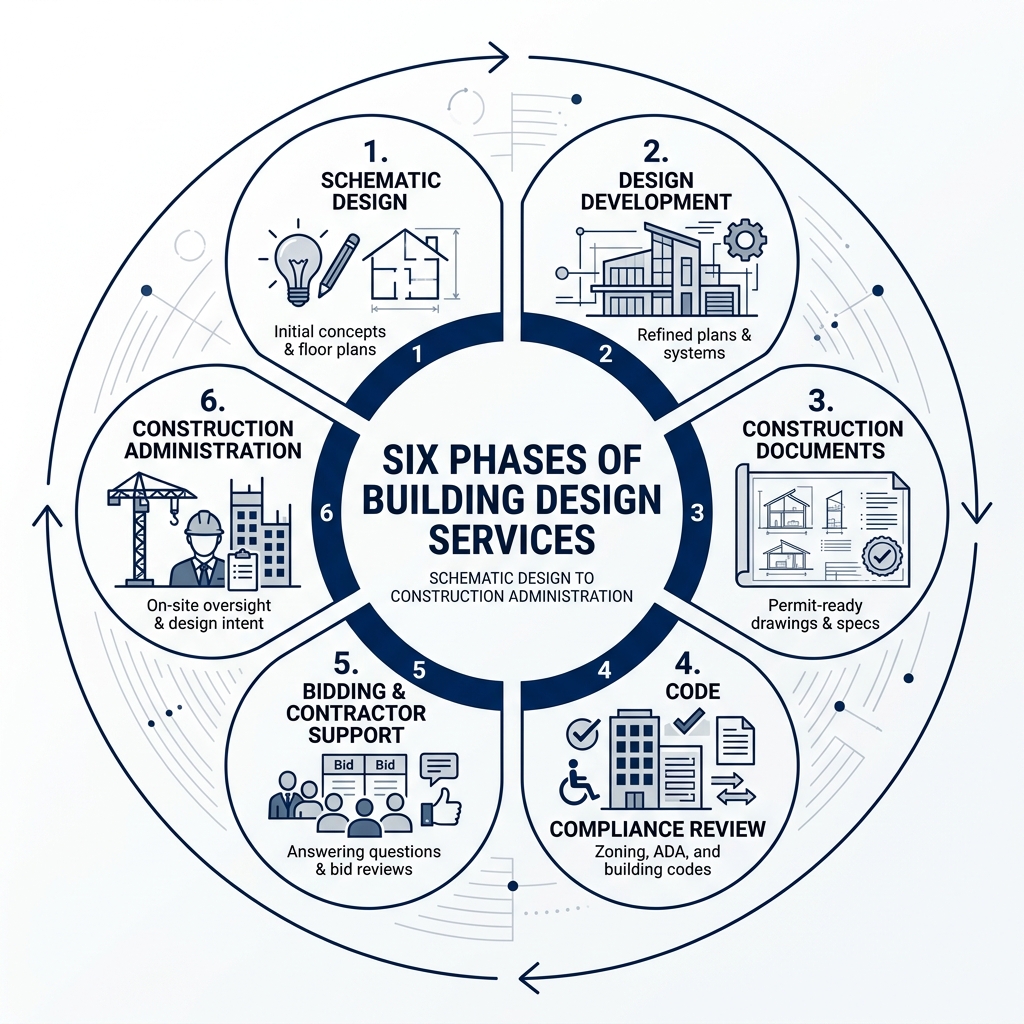
Building Design Services terms explained:
Understanding Professional Building Design Services
When we talk about Building Design Services, we are referring to a highly integrated discipline that bridges the gap between a creative vision and a physical structure. It isn’t just about drawing pretty pictures; it’s about architectural drafting and design that accounts for every stud, pipe, and electrical outlet. At Keiser Design Group, we believe that the best designs are those that balance aesthetics with technical precision.
Professional services ensure that your building plans and designs are more than just conceptual. They must be permit-ready documents that a contractor can actually use to build. This involves engineering integration, where structural, mechanical, and electrical systems are woven into the architectural fabric.
Our building design services emphasize practical decision-making, material performance, and efficient space planning so the final design supports your project goals. This doesn’t mean “cutting corners”; rather, it’s about space optimization and selecting materials that provide the best performance for your investment. Our goal is to move each project from concept through construction documentation with clarity, coordination, and fewer surprises.
The Role of Specialized Building Design Services in Compliance
One of the most overlooked aspects of building design is the complex web of regulations. Specialized Building Design Services act as your shield against legal and safety risks. We ensure every project adheres to:
- ADA Regulations: Ensuring accessibility for all individuals, which is a legal requirement for commercial and multi-family spaces.
- Zoning Ordinances: Navigating local laws in cities like Newark or Delaware, OH, to ensure your building height, setbacks, and usage are allowed.
- IECC Energy Calculations: Modern buildings must meet strict energy efficiency standards. We provide the necessary heat loss and mechanical equipment certifications to prove compliance.
- Structural Seals: Every set of professional prints should be reviewed and sealed by a Licensed Professional Engineer or Structural Engineer to guarantee they can withstand wind, snow, and seismic loads.
For those looking for specific product standards, resources like the Directory of building products and standards help designers select certified materials that meet rigorous safety tests.
How to Choose the Right Building Design Services for Your Scale
Not every firm is the right fit for every project. Identifying your project’s scale is the first step in selecting a partner.
- Custom Homes: These require a high level of personal collaboration. We focus on creating a “functional sanctuary” that reflects your lifestyle, whether it’s a cozy 2,000-square-foot home or a 12,000-square-foot estate.
- Multi-Family Developments: These projects demand expertise in density, shared amenities, and community placemaking.
- Large-Scale Commercial & Industrial: From automotive dealerships to massive warehouses, these require strategic coordination and a deep understanding of operational efficiency.
By understanding the nuances of commercial and residential building design, you can choose a firm that has the specific experience needed to handle your project’s unique challenges.

Project Delivery Alternatives: Design-Build vs. Traditional Models
How your project is delivered has a direct impact on communication, coordination, and the overall project experience. Traditionally, many owners used the “Design-Bid-Build” model, where they hired an architect and a contractor separately. Today, many are turning to the Design-Build alternative.
| Feature | Traditional (Design-Bid-Build) | Design-Build (Turnkey) |
|---|---|---|
| Responsibility | Split between Architect & Contractor | Single-source responsibility |
| Cost Input | Costs known after design is finished | Early cost input during design |
| Relationship | Can become adversarial | Team alliance and collaboration |
| Timeline | Linear (Step-by-step) | Fast-tracking (Overlapping phases) |
| Change Orders | More frequent due to gaps in docs | Minimized through integrated planning |
In a commercial design-build scenario, the owner contracts with one entity. This “turnkey” approach fosters a team alliance where the designer and builder work together from day one. This integrated approach improves collaboration between the design and construction teams and helps keep decisions aligned throughout the project.
Streamlining the Design-Build Workflow
The efficiency of design-build comes from its phased approach. Instead of waiting months for a full set of blueprints before talking to a builder, the process is streamlined:
- Preliminary Feasibility: We start by looking at the land and your goals to see if the project is viable.
- Facility Investigation: Analyzing existing conditions or soil reports to avoid “surprises” underground.
- Schematic Development: Creating the first visual concepts and layouts.
- Construction Documents: Finalizing the technical details while the contractor is already pricing materials.
This overlap, often called “fast-tracking,” allows a contractor to begin site work or foundations while we are still finalizing interior finishes. It can shorten decision cycles and reduce delays by allowing key project activities to overlap when appropriate.
Sustainable and High-Performance Design Standards
Today’s property owners are looking for more than just a roof over their heads; they want spaces that perform over time. Sustainable Building Design Services focus on creating structures that are regenerative, self-sufficient, and resilient.
We often look toward high-performance standards to guide our work:
- LEED Certification: A globally recognized symbol of sustainability achievement. You can find more LEED platinum certification info to see how these ratings improve building value.
- Passive House: This standard focuses on a “super-insulated” building envelope and airtight construction to reduce energy usage by up to 90%.
- Living Building Challenge: A rigorous standard that views buildings as regenerative spaces that give back more to the environment than they take.
These building design services can include non-toxic materials, efficient HVAC strategies, and resilient envelopes that support healthier, more comfortable interior environments.
Technical Consulting and Specialized Resource Integration
Building Design Services are not only about the overall look and layout of a project. They also involve the technical decisions that help a building perform well over time. That is where specialized consulting matters. For complex commercial projects, this can include roofing coordination, drainage planning, detailing, and other building science considerations that support durability, code compliance, and long-term performance.
Specialized integration also includes:
- Safety Engineering: Learning from past building issues to ensure your new project is built to last.
- Large-Span Engineering: Specialized designs for agricultural or industrial buildings that require wide open spaces.
- High-Quality Products: Incorporating reliable component into the design phase ensures that every opening is functional and secure.
- Building Skin Testing: Checking the exterior of the building for air and water leaks before the project is finished.
By integrating these technical resources early, we ensure that your building is durable and easy to maintain for decades to come.
Frequently Asked Questions about Building Design Services
What is the difference between a building designer and a traditional architecture firm?
Building designers often focus on residential and light commercial projects with a heavy emphasis on constructability and client collaboration, while traditional firms may handle massive civic or institutional projects. Both provide essential Building Design Services like schematic design and construction documentation. It is important to avoid the risks of DIY home design; professional architectural services are a necessity to ensure your project is safe, legal, and structurally sound. At Keiser Design Group, we pair architectural expertise with a client-first process designed around communication, clarity, and long-term partnership.
How does the design-build approach save time and money?
When design and construction teams collaborate early, building design services can move forward with better coordination between documentation, sequencing, and field execution. This eliminates the adversarial relationship between designer and contractor, reducing legal fees and costly change orders. It also gives owners earlier alignment on scope, sequencing, and construction planning.
What specific documents are included in a professional design package?
A comprehensive package typically includes site plans, floor plans, exterior elevations, structural sections, electrical layouts, and detailed schedules for finishes, doors, and windows to ensure accurate bidding and construction. These documents serve as the “instruction manual” for your builder and the legal basis for your building permit.
Conclusion
Selecting the right partner is one of the most important decisions in shaping a smooth process, code-ready documentation, and a successful project outcome. Whether you are in Columbus, Ohio, or any of our service areas across the Midwest and South, the goal remains the same: a beautiful, functional space achieved through a simple, worry-free process.
Keiser Design Group offers a tailored experience, blending expert architectural vision with a simplified development process that puts your needs first. We approach every project with collaboration, technical expertise, and integrity.
If you are planning a new build, renovation, or commercial project, contact Keiser Design Group to discuss the building design services that best fit your goals, timeline, and project requirements.