What Makes Indiana Architecture Worth Exploring
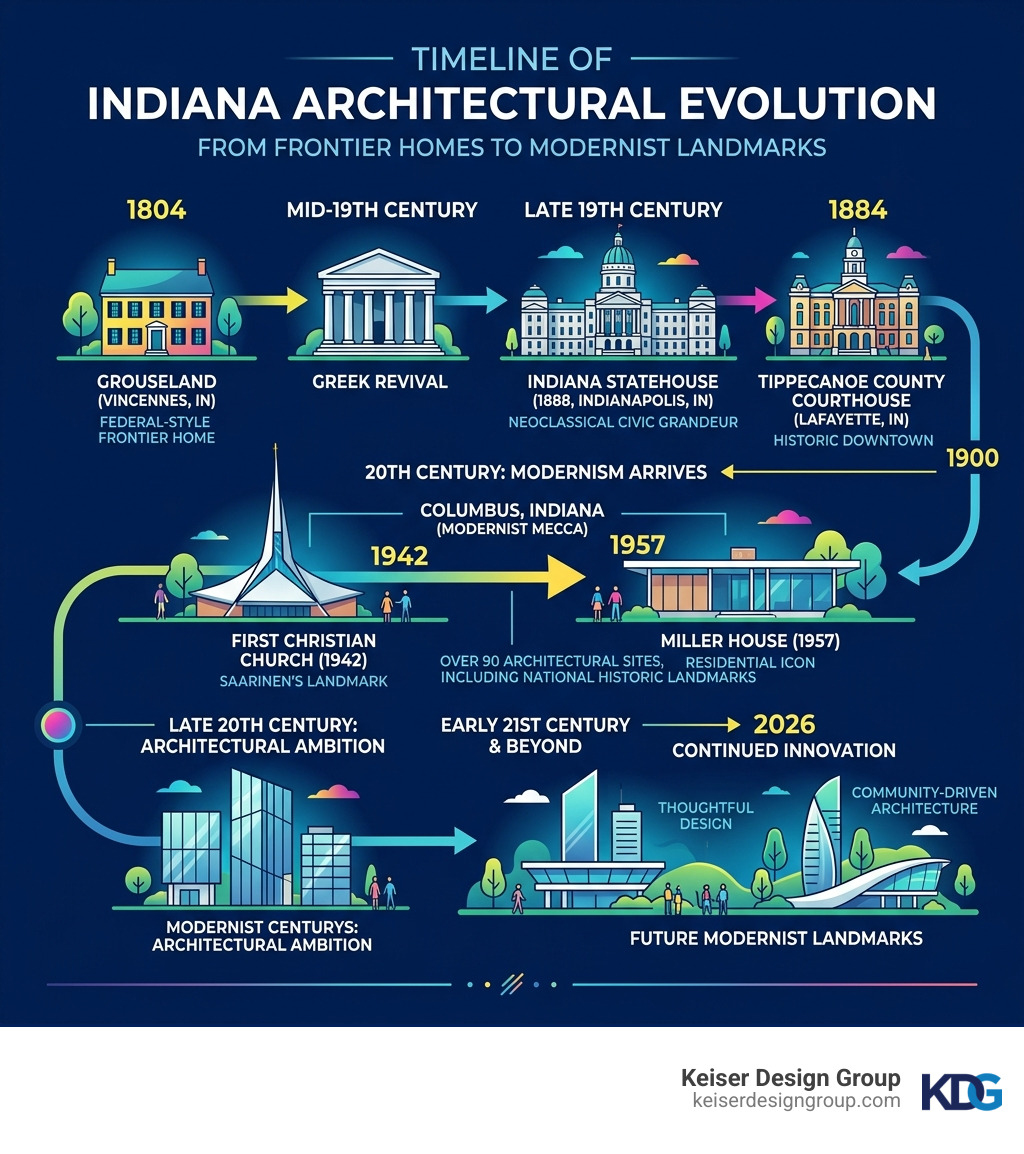
Indiana Architecture is one of America’s most unexpectedly rich built environments, spanning from an 1804 Federal-style frontier home to a Midwestern city shaped by some of the greatest architects of the 20th century.
Here are the most notable highlights at a glance:
| Category | Standout Example | Location |
|---|---|---|
| Modernist Landmark | First Christian Church (1942) | Columbus, IN |
| Civic Grandeur | Indiana Statehouse (1888) | Indianapolis, IN |
| Residential Icon | Miller House (1957) | Columbus, IN |
| Oldest Structure | Grouseland (1804) | Vincennes, IN |
| Historic Downtown | Tippecanoe County Courthouse (1884) | Lafayette, IN |
| Academic Hub | J. Irwin Miller Architecture Program | IU Bloomington/Columbus |
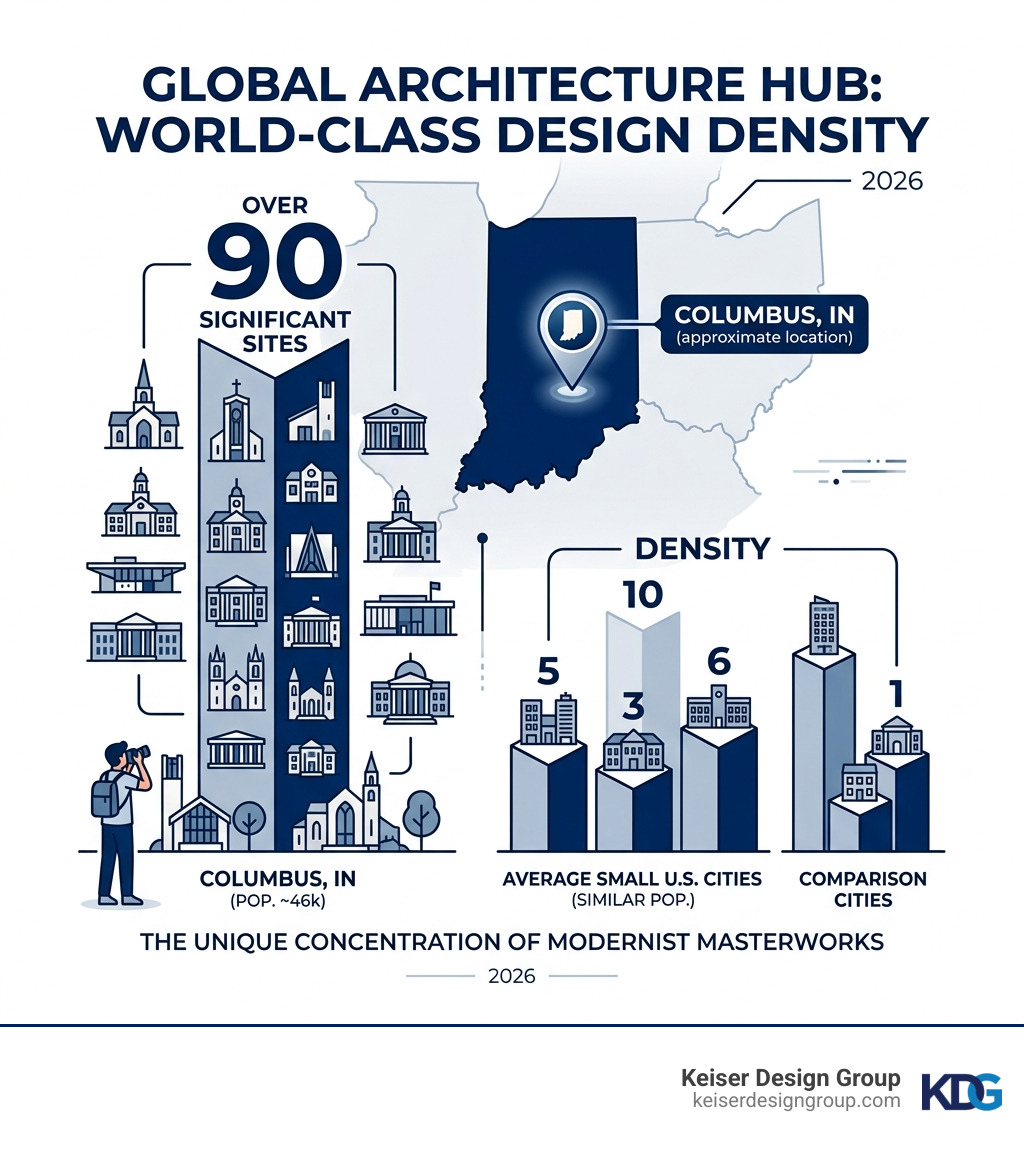
Indiana’s architectural story is one of unexpected ambition. Columbus, a city of just over 50,000 people, is home to more than 90 architectural sites, including work by global figures such as Eero Saarinen, I.M. Pei, Richard Meier, and Robert Venturi. Seven of those buildings are National Historic Landmarks. J. Irwin Miller’s guiding belief was clear: communities benefit when design excellence is treated as a civic priority.
That philosophy shaped not just one city, but set a standard for what thoughtful, community-driven design can achieve across an entire state.
I’m Dan Keiser, founder and principal architect of Keiser Design Group, and with over 30 years of hands-on experience in architectural design and project management, I’ve had a front-row seat to the evolving story of Indiana Architecture and the broader region. In this guide, I’ll walk you through the landmarks, modernist masterworks, and practical design lessons that make Indiana Architecture worth studying.
The Modernist Mecca: Exploring Columbus, Indiana Architecture
When you think of global architecture hubs, names like Chicago, New York, or Paris usually top the list. Within Indiana Architecture, Columbus holds a rare place of influence, often discussed alongside much larger design destinations. This small city is often described as a living museum of 20th-century Modernism, with more than 90 architecture sites that give it national significance.
The transformation of Columbus began with J. Irwin Miller, the former chairman of Cummins. Miller believed that for a community to thrive, it needed to be surrounded by excellence. In 1954, he established the Cummins Foundation, which began a unique program: the foundation would pay the architectural fees for public buildings, provided the city chose from a list of world-class architects.
This corporate philanthropy turned the town into a laboratory for the story of the Columbus architecture collection. It wasn’t just about building schools or fire stations; it was about creating a civic identity rooted in high-quality design, which underscores the necessity of professional architectural services. Today, the city is home to seven National Historic Landmarks, proving that great design is a long-term investment in community pride.
The Saarinen Legacy in Indiana Architecture
A defining modernist chapter in Indiana Architecture began in Columbus in 1942 with the completion of First Christian Church, designed by Eliel Saarinen. It was one of the first contemporary-style churches in the United States, breaking away from traditional Gothic or colonial styles with its asymmetric design and clean lines.
His son, Eero Saarinen, expanded that legacy and further defined Indiana Architecture through civic, commercial, and residential design. Eero’s contributions are legendary:
- The Miller House (1957): The Miller House became a landmark of residential design in Columbus, showcasing the open-plan concept before it became common in American homes. It is famous for its 15-foot-square conversation pit—a sunken seating area that encouraged social interaction without the clutter of traditional furniture.
- The Irwin Conference Center (1954): Originally a bank, this glass-walled structure challenged the idea that financial institutions needed to look like heavy stone fortresses.
- North Christian Church (1964): Known for its soaring 192-foot spire, this hexagonal building was Eero’s last work in the city, blending spirituality with geometric precision.
Together, these projects show how residential design, civic planning, and commercial innovation can work together when a community commits to design excellence.
Global Masters in a Small Town
The Cummins Foundation’s list didn’t stop with the Saarinens. A walk through Columbus reveals a concentrated ‘who’s who’ of architectural history.
I.M. Pei designed the Cleo Rogers Memorial Library, creating a brick-clad cultural anchor for the downtown. Richard Meier designed the white, light-filled Clifty Creek Elementary School. Robert Venturi, a pioneer of Postmodernism, gave the city Fire Station 4 in 1967, which famously used a massive “4” on the exterior as a graphic design element.
More recent work by Deborah Berke and firms such as IwamotoScott shows that Columbus remains a forward-looking design destination, not simply a preserved modernist collection.
Historic Landmarks and Civic Grandeur Across the Hoosier State
While Columbus captures the modernist spotlight, the rest of Indiana offers a deep well of historic and civic grandeur. The Architectural Design of the Statehouse is perhaps the best example of Indiana’s 19th-century ambition.
Completed in 1888 for just under $2 million, the Indiana Statehouse is a stunning example of Renaissance Revival style. Its cruciform plan and central domed rotunda were heavily influenced by the National Capitol in Washington, D.C. The building features French convex-roofed pavilions at its corners and utilizes high-end materials like marble shafts, limestone, and granite. It remains the heart of Indiana’s government and a testament to the craftsmanship of the era.
| Structure | Era | Style | Notable Feature |
|---|---|---|---|
| Indiana Statehouse | 1888 | Renaissance Revival | 100+ foot inner dome |
| Scottish Rite Cathedral | 1929 | Neo-Gothic | Largest building of its kind |
| West Baden Springs Hotel | 1902 | Beaux-Arts | 200-foot wide atrium dome |
| Tippecanoe County Courthouse | 1884 | Second Empire | Massive 167-foot dome |
Indianapolis: A Hub for Monumental Indiana Architecture
Indianapolis serves as an anchor for Indiana Architecture, blending historic preservation with modern development. The Scottish Rite Cathedral (1929) is a Neo-Gothic masterpiece, while the Soldiers and Sailors Monument defines the city’s “Circle City” layout.
For those looking to research specific sites, the Indiana Architecture Database is an invaluable resource. It catalogs everything from the 1929 Scottish Rite to the 2000 NCAA Hall of Champions. For commercial projects, these historic anchors show why thoughtful planning, durable materials, and clear design intent matter from the beginning.
From Vincennes to Lafayette: Preserving the Past
The architectural story of Indiana stretches back further than the statehouse. In Vincennes, you’ll find Grouseland, the 1804 home of William Henry Harrison. Completed in 1804, this Federal-style mansion is one of Indiana’s most important early architectural landmarks.
Moving north to West Lafayette, the vibe shifts from the 1800s to the 1950s with the Samara House, designed by Frank Lloyd Wright. This Usonian-style home is a perfect example of Wright’s philosophy of organic architecture, integrating the building into the natural landscape.
In Lafayette, the Tippecanoe County Courthouse, completed in 1884, remains a prominent example of 19th-century civic architecture. The city’s downtown has remained largely intact, with historic commercial buildings now supporting modern specialty shops and galleries—a great example of mission-minded architectural solutions that preserve the past while fueling the future and underscore the necessity of professional architectural services.
Education and Innovation: Shaping the Future of Design
Indiana Architecture is not only preserved; it is also taught to the next generation of designers. The J. Irwin Miller Architecture Program at Indiana University is a prime example, connecting architectural education with Columbus’s nationally recognized design legacy.
Housed in Columbus’s nationally landmarked Republic Building, designed by Myron Goldsmith, the program is part of Indiana’s small group of NAAB-accredited architecture degrees. You can learn more about the Master of Architecture at IU Bloomington and how it integrates studio art with architectural practice.
Advancing the Legacy of Indiana Architecture
The IU program emphasizes a “Nomadic Studio” approach, where students travel to international cities for comparative studies. However, their home base in Columbus serves as the ultimate classroom. Recent initiatives like Exhibit Columbus bring contemporary installations to the city, creating a dialogue between the modernist masterworks and new, sustainable urbanism.
From educational facility planning to community-driven projects like the NexusPark bus shelter, Indiana’s architectural scene is constantly evolving, proving that the necessity of professional architectural services is vital for modern growth. These projects show that the Columbus model of community engagement and high-quality design continues to influence Indiana Architecture today.
Resources for Architectural Exploration
If you are looking to explore Indiana Architecture firsthand, there are several ways to dive in:
- Self-Guided Walking Tours: Both Columbus and Lafayette offer robust walking tour maps that highlight historic districts and modernist landmarks.
- Indiana Landmarks: This organization is the largest statewide preservation group in the U.S., offering tours and resources for historic homes and public buildings.
- Architecture Databases: Beyond the official state database, checking regional architectural insights can help you understand how Indiana’s styles compare to neighboring hubs like Cincinnati.
Conclusion
From the frontier brickwork of Grouseland to the glass-and-steel innovations of Columbus, Indiana Architecture is a testament to what happens when a community values design. Whether it’s the soaring dome of the Statehouse or the intimate “conversation pit” of the Miller House, these structures do more than provide shelter—they inspire the people who live and work within them.
At Keiser Design Group, we believe that every project, whether a new development in Indianapolis or a renovation in Fort Wayne, deserves that same level of intentionality. We help clients translate vision into buildable plans through a collaborative process grounded in precision, safety, and code awareness. Our team provides tailored architectural guidance and a clear, collaborative process designed to help your project become a lasting part of its community. Contact Keiser Design Group today to start a conversation about your next residential, commercial, or mission-minded project.